

The biggest concern of most website owners is ranking, traffic, and quality of content. Nevertheless, most of them do not take into consideration a tiny file that is examined by search engines prior to exploring a website. That file is robots.txt. Even a minor mistake within its walls can lead to issues that can take weeks to be felt. Search engines can search pages without seeking content of your preference or avoiding pages on the target you would have assumed the engine would search. It is one of the reasons why the number of search results concerning the generate robots.txt files spellmistake has grown. Individuals are more enlightened about technical SEO errors that silently affect performance. Although the robots.txt file appears as a plain text file, it manages a crucial aspect of interaction between the search engine and a webpage. One spelling error can alter the message of an instruction and produce unforeseen SEO problems. In this article, you will learn what robots.txt does, why spelling mistakes matter, the most common errors website owners make, and how to create a file that search engines can understand correctly.
What Is a Robots.txt File and How Does It Affect Website Crawling?
A robots.txt file occurs in the top-level of a website. This file is usually checked by the search engine crawlers when they visit a site. The file contains instructions regarding the parts of the site that crawlers are allowed to access and parts that they are not allowed to access.
An average robots.txt file is capable of affecting the search engine efficiency in terms of resource consumption during the crawl. Huge sites may consist of thousands of URLs. In some of those URLs, there will be value to users, but in others, the URLs are of administrative or technical use. Robots.txt serves to direct search engines to the pages that are important.
The file usually appears at:
| https://yourwebsite.com/robots.txt |
Although the file contains only a few lines of text, it plays an important role in technical SEO. When configured correctly, it improves crawl efficiency and helps search engines discover important content more effectively.
Key Directives Used in Robots.txt
| Directive | Purpose |
| User-agent | Specifies the crawler |
| Disallow | Blocks access to a URL or folder |
| Allow | Permits access to specific pages |
| Sitemap | Shows the sitemap location |
Most website owners never need a complicated robots.txt file. However, they do need an accurate one.
Why Most Robots.txt Errors Go Undetected for Months
One reason robots.txt mistakes are dangerous is that they rarely generate visible warnings. A typo within robots.txt does not make the website show an error like a broken webpage or server error does. The search engines keep crawling according to what they comprehend in the file. They might just disregard a directive in case they fail to understand it. On the other hand, users of the web versions are under the illusion that everything is fine, since they cannot notice the issue.
Robots.txt problems are often learned of by many SEO professionals during technical audits, crawl analysis, or investigations of indexing. The issue can already impact crawling efficiency and organic exposure at that time. This non-verbal action renders robots.txt one of the most disregarded aspects of technical SEO.
Why Are People Searching for Generate Robots.txt Files Spellmistake?
The phrase generate robots.txt files spellmistake may sound unusual at first. Yet it reflects a genuine concern among website owners, developers, bloggers, and SEO professionals. Many users search this term because they recently discovered an error in their robots.txt file. Others want to create a new file and avoid making mistakes from the beginning. Unlike broken links or server errors, robots.txt mistakes often remain invisible. The file loads normally in a browser. No warning appears on the website. Search engines simply interpret the file differently than intended.
That silent behavior makes robots.txt errors particularly dangerous. For example, a website owner may think they blocked a private directory from crawling. Meanwhile, search engines continue crawling it because a single word was misspelled. The website owner may not notice the issue until duplicate content or indexing problems appear.
Generate Robots.txt Files Spellmistake Issues That Website Owners Commonly Face
Most robots.txt problems come from human error rather than technical complexity. People often create the file manually, copy instructions from old websites, or make quick edits without testing them. Consequently, small spelling and formatting mistakes become surprisingly common.
Some mistakes only affect a single rule. Others can prevent search engines from understanding entire sections of the file. The following errors appear repeatedly during SEO audits and technical website reviews.
Critical Robots.txt Errors That Search Engines Often Ignore
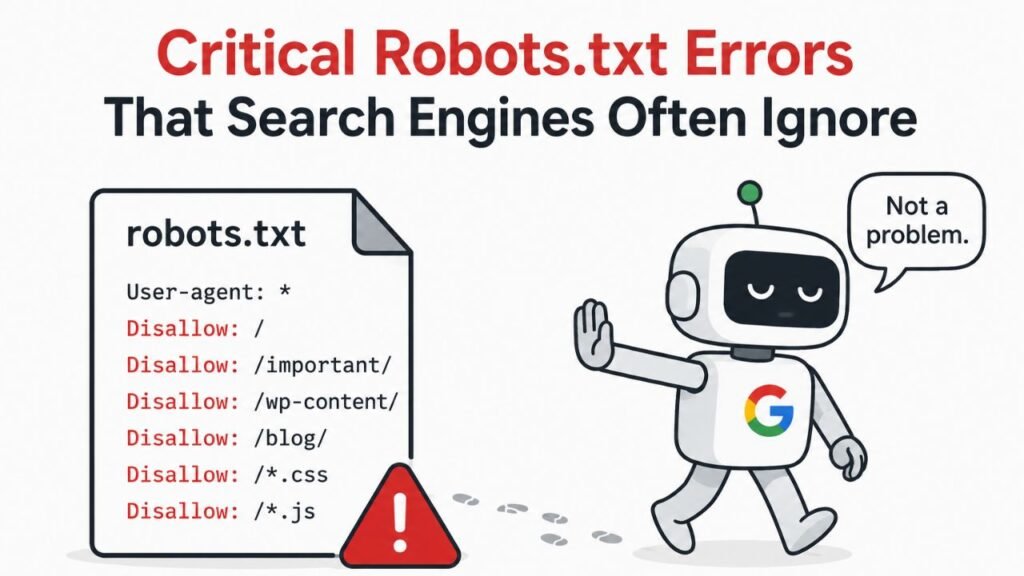
Many spelling mistakes look harmless because they involve only one character. Yet search engines rely on specific directives. If the wording changes, the crawler may ignore the instruction completely.
1. Misspelling “User-agent”
The User-agent directive tells crawlers which bot the rules apply to.
The correct version looks like this:
| User-agent: * |
Many people accidentally write:
| UserAgent: * |
Or
| User agent: * |
Although these variations appear similar, they do not follow the expected syntax. When search engines encounter an invalid User-agent directive, they may ignore the rules attached to it. Consequently, crawling behavior becomes unpredictable.
A technical SEO audit performed on a medium-sized ecommerce site revealed exactly this problem. The website owner used “UserAgent” instead of “User-agent.” As a result, Google ignored multiple crawling instructions that the owner believed were active.
2. Misspelling “Disallow”
The Disallow directive appears in most robots.txt files. It also generates the highest number of mistakes.
The correct format is:
| Disallow: /private/ |
Common variations include:
| Disalow: /private/ |
| Dissallow: /private/ |
Even though the difference involves only one letter, the directive no longer works as intended. Many website owners discover this issue after search engines begin indexing directories that were supposed to remain hidden.
3. Misspelling “Allow”
The Allow directive helps search engines access specific content within restricted sections.
A correct version looks like:
| Allow: /public-page/ |
Common mistakes include:
| Alow: /public-page/ |
And
| Allow : /public-page/ |
These errors may cause search engines to ignore exceptions that website owners intended to create.
For example, an ecommerce store might block an entire directory while allowing one product page. If the Allow directive contains a typo, that page may never receive the intended access.
4. Getting the Colon and Spacing Wrong
Not every robots.txt problem involves spelling. Formatting errors also create issues.
Correct formatting:
| Disallow: /admin/ |
Incorrect formatting:
| Disallow:/admin/ |
Or
| Disallow : /admin/ |
Some search engines handle minor spacing issues gracefully. Others may not.
Thus, consistency is the safest practice. The correctly formatted robots.txt document enhances readability and minimises the possibility of interpretation errors.
5. Wrong File Name or Location
Many administrators of websites are concentrated on instructions and abandon the file itself. It doesn’t matter how well written a robots.txt file is, as long as it is in the incorrect location.
The file must be named:
| robots.txt |
Common mistakes include:
- Robot.txt
- Robots.txt.txt
- robotstxt
- robots.TXT
The file must also sit at the domain root.
Correct location:
| https://example.com/robots.txt |
Incorrect location:
| https://example.com/blog/robots.txt |
Search engines may never find the file if it appears in the wrong directory.
6. Using Tabs Instead of Spaces
This problem is not as common, but it creates difficulties. There are text editors that automatically insert tab characters. Humans barely distinguish between tabs and spaces, but some parsers can view tabs and spaces differently.
A normal place is used to establish a cleaner and more reliable structure. The majority of SEO experts suggest plain text editors for writing robots.txt files.
How One Robots.txt Typo Can Cause Ranking and Indexing Problems
Most website proprietors never consider the effects of robots.txt errors since the file seems straightforward.
A real-life situation illustrates why such an assumption might prove to be an expensive thing. Take an example of a company launching a redesigned site. During the launch process, a developer creates the following rule:
| User-agent: *Disalow: /staging/ |
The intention is obvious. The staging directory should remain hidden from search engines.
Unfortunately, the word “Disallow” contains a spelling mistake. Search engines do not recognize “Disalow.” Consequently, they ignore the instruction and crawl the staging environment.
Over time, duplicate pages enter the index. Search engines begin seeing multiple versions of the same content. Crawl resources get wasted. Organic visibility gradually declines.
The frustrating part is that nobody notices immediately. The robots.txt file appears normal at a glance. The problem only becomes obvious after rankings, crawl reports, or indexing patterns begin showing unusual behavior.
How Robots.txt Errors Affect SEO
| Issue | SEO Impact |
| Hidden typo | Crawlers ignore directives |
| Incorrect blocking | Important pages disappear from crawl paths |
| Duplicate content exposure | Ranking signals become diluted |
| Crawl budget waste | Search engines spend time on low-value URLs |
| Wrong file placement | Crawlers never find the file |
Even though fixing the typo may take only a few minutes, recovering from the SEO consequences often takes much longer.
What Happens When Search Engines Misread Robots.txt Rules?
Search engines follow robots.txt instructions literally. In case of invalid syntax or misspelling of instructions, crawlers might take the instructions in a different light. An example is that a Disallow directive that is misspelled can be used to allow crawlers to access the parts that ought to be private. On the other hand, inaccurately written Allow instructions might result in the crawling of key content being overlooked.
The outcome can be a mixture of wasted crawl budget, problems with duplicated content, and indexing inefficiencies. In the long term, these issues may have an impact on the way search engines interpret the website setup.
Potential SEO Consequences
| Issue | Possible Impact |
| Duplicate content | Ranking dilution |
| Excessive crawling | Crawl budget waste |
| Hidden pages indexed | Reduced content quality signals |
| Important pages skipped | Lower organic visibility |
| Broken crawl directives | Search engine confusion |
Generate Robots.txt Files Spellmistake Fix: Creating a Clean Robots.txt File
Creating a robots.txt file does not require advanced technical skills. Nevertheless, it is not without detail. The most secure method is with a clear structure and checking all directives before their publication.
Most SEO experts advocate practicing with a basic version and extending it when they need to. Complicated files usually cause unjustifiable jeopardy. This should not involve the generation of the longest possible robots.txt file. Rather, there must be an aim to create a file that is intelligible to search engines.
Why Robots.txt Generator Tools Reduce Human Error
Generator tools reduce human error by creating valid syntax automatically. All one has to do is choose the rules required and the tool will create the appropriate structure.
Benefits include:
- Faster setup
- Reduced spelling mistakes
- Cleaner formatting
- Easier management
For beginners, generators provide a practical starting point because they remove much of the guesswork associated with manual creation.
Manual Robots.txt Creation: Benefits and Risks
Manual creation is more flexible and controllable. This method is favored by many very experienced professionals in the sphere of SEO, since it provides them with custom configurations.
A basic structure often looks like:
| User-agent: *Disallow: /admin/ Sitemap: https://yourwebsite.com/sitemap.xml |
In the manual state of editors, it is necessary to go through each line. One character lost will result in the remaining file being interpreted differently by the search engines.
What Technical SEO Experts Check Before Publishing a Robots.txt File
Experienced SEO professionals rarely publish a robots.txt without testing various important aspects of it. Although there might be a limited number of lines in the file, every command can manipulate the way search engines communicate with the site. Before deployment, professionals commonly run checks on the spelling of instructions, check directory paths, scan sitemap URLs, and debug crawler access using validation tools. They also verify that there are new updates to the rules of crawling that are necessitated by changes in recent websites.
This review process helps prevent avoidable mistakes that could later affect indexing and search performance.
Expert Review Checklist
- Verify User-agent syntax
- Check Disallow and Allow directives
- Confirm sitemap location
- Review blocked directories
- Test critical URLs
- Validate through Search Console
Robots.txt Generator vs Manual Setup: Which Method Is Better?
Many web publishers come to a juncture where they must decide between creating a robots.TXT file by hand or resorting to a robots.TXT generator. Each of the two methods can generate a perfectly valid file. This is normally reduced to experience, complexity of the websites, and chances of committing errors.
A simple manually-created file can be sufficient in case your website has just a few pages. Nevertheless, when you have an ecommerce store, publication platform, or website whose size includes numerous directories, a generator can save time and minimize risk.
Consistency is the largest benefit of generator tools. They will obey appropriate syntax naturally. In the meantime, the manual generation provides malleability with the need to be more careful with the details.
Manual Creation Steps
Creating a robots.txt file manually is straightforward when you follow a structured process. Start by opening a plain text editor. Avoid rich-text applications because they may insert hidden formatting characters. Then add the required directives carefully.
A typical workflow looks like this:
- Open a plain text editor.
- Add the User-agent directive.
- Add Disallow or Allow rules.
- Include the sitemap URL.
- Save the file as robots.txt.
- Upload it to the root directory.
- Test it before making it live.
Many SEO professionals still prefer manual editing because it allows complete control over every rule.
Using a Generator Tool Steps
A generator tool simplifies the process significantly. Most tools use a form-based interface where users select options rather than typing directives manually.
The process generally follows these steps:
- Open a robots.txt generator.
- Select the crawler settings.
- Enter folders or URLs to block.
- Add your sitemap URL.
- Generate the output.
- Download or copy the file.
- Upload it to your website.
For beginners, generators provide a safer path because they reduce the likelihood of a robots.txt file spelling mistake.
Manual Creation vs Generator Tools Comparison
Choosing between these approaches depends on your requirements.
| Feature | Manual Creation | Generator Tool |
| Flexibility | High | Moderate |
| Learning Curve | Higher | Lower |
| Error Risk | Medium to High | Low |
| Setup Time | Moderate | Fast |
| Suitable for Beginners | Limited | Yes |
| Complex Configurations | Excellent | Good |
Many SEO consultants use both methods depending on the project. Small websites often benefit from generators, while larger websites sometimes require custom manual rules.
Correct Robots.txt Examples for Common Scenarios
A robots.txt file does not follow a single universal structure. Different websites require different configurations. A news website has different needs than an online store. Likewise, a staging server requires rules that a live website would never use.
Understanding common configurations helps website owners avoid mistakes and implement rules correctly.
Allow All Crawling (No Restrictions)
Some websites want search engines to access every page.
The simplest configuration looks like this:
| User-agent: *Disallow: |
An empty Disallow directive tells crawlers that they can access all available content. This setup works well for small websites that do not have private directories or restricted sections.
Block All Crawling (e.g., Staging Sites)
Development environments should usually remain hidden from search engines.
The following configuration blocks all crawling:
| User-agent: *Disallow: / |
The slash symbol represents the entire website. A common mistake occurs when developers forget to remove this directive after launching a website. As a result, search engines cannot crawl important pages.
Block a Specific Directory
Many websites contain directories that should remain private.
For example:
| User-agent: *Disallow: /private/ |
This rule prevents crawlers from accessing everything inside the private directory.
Block a Specific File
Sometimes only one page requires protection.
Example:
| User-agent: *Disallow: /secret-page.html |
This directive blocks access to a specific file rather than an entire folder.
Block a Specific Bot (e.g., AhrefsBot)
Some website owners choose to block specific crawlers.
Example:
| User-agent: AhrefsBotDisallow: / |
This instruction blocks AhrefsBot while allowing other crawlers to continue operating normally.
Allow Googlebot, Block Everything Else
Certain websites use highly specific crawler rules.
Example:
| User-agent: GooglebotDisallow: User-agent: *Disallow: / |
In this case, Googlebot receives access while all other bots remain blocked.
Standard E-Commerce Configuration
Online stores often contain checkout pages, account pages, and administrative sections that do not belong in search results.
A common ecommerce setup looks like this:
| User-agent: *Disallow: /checkout/Disallow: /cart/Disallow: /account/Disallow: /admin/ Sitemap: https://yourstore.com/sitemap.xml |
This setup helps search engines focus on product and category pages instead of transactional URLs.
How to Verify Robots.txt Rules Before Search Engines Crawl Your Site
Publishing a robots.txt file without testing it creates unnecessary risk. Even a small formatting issue can change how search engines interpret your instructions. Testing takes only a few minutes, yet it can prevent weeks of troubleshooting later. Many SEO professionals consider testing a mandatory step rather than an optional one.
Google Search Console Robots.txt Tester
Google Search Console remains one of the most useful tools for evaluating robots.txt behavior. It helps website owners verify whether specific URLs are blocked or accessible. It also reveals syntax problems that may affect crawling. When using Search Console, focus on important pages first. Product pages, service pages, blog posts, and landing pages should all behave exactly as expected. If Google cannot crawl an important URL, identifying the problem early saves considerable time.
Manual URL Check
One of the easiest verification methods involves checking the live file directly in a browser.
Simply visit:
| https://yourdomain.com/robots.txt |
Review the file carefully.
Look for:
- Incorrect spelling
- Missing directives
- Extra spaces
- Broken sitemap URLs
- Formatting inconsistencies
This simple check often catches mistakes that users overlook during editing.
Third-Party Validators
Several SEO tools can validate robots.txt files automatically. These tools often identify:
| Validation Area | Purpose |
| Syntax Errors | Finds invalid directives |
| Crawl Rules | Verifies crawler access |
| File Accessibility | Ensures the file loads correctly |
| Formatting Problems | Detects spacing issues |
Combining manual reviews with automated testing usually produces the best results.
Robots.txt Best Practices for WordPress, Shopify, Wix, and Custom Sites
Different website platforms handle robots.txt differently. Understanding those differences helps website owners avoid confusion and maintain proper configurations. Although the purpose of robots.txt remains the same across platforms, the implementation often varies.
Managing Robots.txt Files on WordPress Websites
WordPress automatically generates a virtual robots.txt file for many websites. Site owners can also create a physical file manually.
A common WordPress configuration looks like this:
| User-agent: *Disallow: /wp-admin/Allow: /wp-admin/admin-ajax.phpSitemap: https://yourdomain.com/sitemap_index.xml |
This setup blocks administrative sections while allowing important functionality. Many WordPress users manage robots.txt through SEO plugins because those tools simplify editing and reduce formatting mistakes.
Shopify Robots.txt Settings and Crawl Management
Shopify handles much of the robots.txt configuration automatically. For most store owners, the default setup works well. Shopify already blocks many unnecessary pages and allows access to important content.
Store owners typically only customize robots.txt when they have advanced crawling requirements.
How Wix Handles Robots.txt Configuration Automatically
Wix also creates robots.txt files automatically. Small business owners often appreciate this approach because they do not need to manage technical settings manually.
For websites with standard requirements, Wix’s automated handling usually performs well. Advanced users still have some customization options, although those options remain more limited compared to self-hosted platforms.
Robots.txt Management for Self-Hosted Websites
Custom websites offer complete control over robots.txt. The file typically resides within the root server directory. Because website owners have direct access, they can create highly customized crawling rules.
However, direct control also increases responsibility. A single spelling mistake, incorrect path, or misplaced directive can affect crawling behavior immediately. For that reason, testing becomes even more important on self-hosted websites.
Real SEO Case Study: How One Robots.txt Mistake Impacted Organic Traffic
A mid-sized content website containing approximately 1,000 articles launched a server migration project. The migration itself proceeded smoothly. Pages loaded correctly, redirects worked properly, and users experienced no visible problems. However, one small detail slipped through the review process.
The original robots.txt file contained:
| User-agent: *Disallow: /wp-admin/ |
During migration, a developer manually recreated the file and accidentally typed:
| User-agent: *Disalow: /wp-admin/ |
The missing letter seemed insignificant. Unfortunately, search engines no longer recognized the directive. Over the next several weeks, crawlers began accessing administrative URLs. Crawl reports showed increasing activity in sections that should have remained hidden. Eventually, duplicate and low-value URLs started appearing in indexing reports.
The SEO team initially suspected technical issues elsewhere. They reviewed redirects, server logs, and page templates. Only later did they discover the typo inside robots.txt. Correcting the issue took less than five minutes. Recovery took nearly two months. This example demonstrates why technical SEO often depends on small details. A single character changed the behavior of an entire website.
Common Robots.txt Mistakes Found During Technical SEO Audits
Technical audits frequently reveal similar robots.txt issues across websites of all sizes. Many of these mistakes remain hidden because they do not affect user experience directly. The most common problems include misspelled directives, incorrect directory paths, outdated crawl rules, missing sitemap references, and files uploaded to the wrong location. Auditing robots.txt regularly helps identify these issues before they affect search visibility.
Frequently Found Audit Issues
| Common Mistake | Potential Result |
| Disalow typo | Directives ignored |
| Wrong directory path | Incorrect blocking |
| Missing sitemap | Slower content discovery |
| File in subfolder | Crawlers cannot find it |
| Outdated directives | Crawl inefficiencies |
Final Thoughts on Generate Robots.txt Files Spellmistake and SEO Success
A robots.txt file may look simple, yet it plays a significant role in how search engines discover and crawl content. Small spelling mistakes often create larger problems than most website owners expect because search engines rarely provide obvious warnings when directives fail. That is why understanding generate robots.txt files spellmistake issues can help prevent unnecessary indexing problems, crawl inefficiencies, and ranking losses.
Whether you create the file manually or use a generator tool, accuracy should always come first. Review every directive carefully, verify the file location, and test the configuration before publishing changes. A few extra minutes spent checking robots.txt can protect months of SEO work and ensure search engines follow the instructions exactly as intended. As websites become larger and more complex, accurate crawl management continues to play an important role in maintaining long-term search visibility.
FAQs
A robots.txt file tells search engine crawlers which parts of a website they can access and which sections they should avoid.
Yes. A typo can cause search engines to ignore directives, which may lead to crawling and indexing issues that affect SEO performance.
The file must sit in the root directory of the website and remain accessible through yourdomain.com/robots.txt.
Not necessarily. Robots.txt controls crawling. Search engines may still index a URL if other websites link to it.
Most websites benefit from having one because it helps manage crawler behavior and improves crawl efficiency.
Review the file after major website updates, migrations, redesigns, or structural changes to ensure the directives still work correctly.
Directive names are generally flexible, but URL paths often remain case-sensitive depending on the server configuration.
Use a reliable generator or carefully review a manually created file, then test it through validation tools before publishing.
Explore More Tools: