
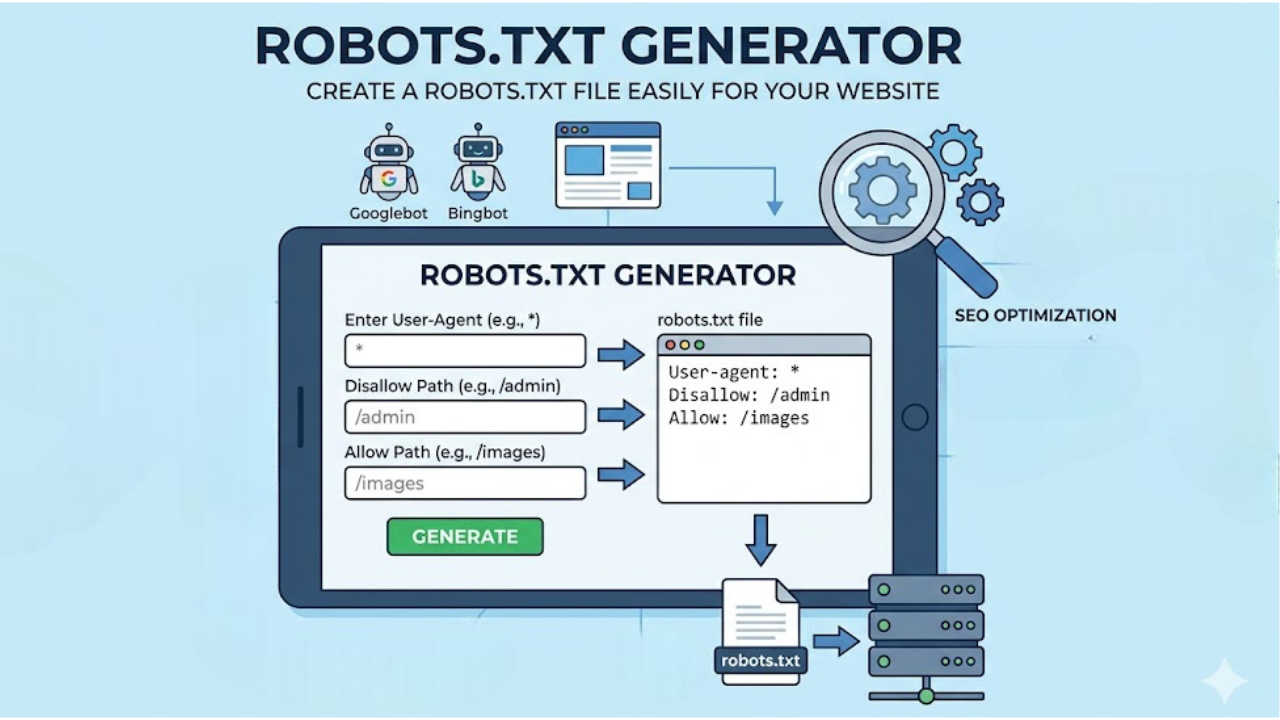
A few years ago, while working on a content-heavy website, I noticed that several newly published articles were not appearing in search results. The content was optimized, the pages loaded quickly, and the sitemap worked perfectly. Once further research uncovered the problem was merely a robots.txt rule that disallowed an essential folder. A single line had a dozen pages. It is actually much more common than one would imagine. Search engines are obedient. In case those instructions are incorrect, useful information will remain hidden. It is precisely due to that reason that a large number of website owners depend on a robots.txt generator as opposed to manually creating files.
The right tool assists you in making clean instructions, eliminating technical errors, and enhancing crawling speed. In this article, you will learn about robots.txt files, how they operate, and which ones are effective in 2026. You will also learn about the advantages of using a custom robots.txt generator for bloggers if you manage a Blogger website.
About Robots.txt Generator
Search engines do not randomly visit every page on a website. They usually view the robots.txt file in the root directory of the website before crawling the content. It is a tiny text file that is kept in the root of a webpage, normally located within the address of a website, such as in part of yourwebsite.com/robots.txt. This file has instructions that direct crawlers to the significant content and stay off areas that do not require indexing. The idea may sound easy, but manually writing these instructions can be complex. Experienced owners of websites do not make mistakes all the time.
The work of this can be simplified by a robots.txt generator. Users are able to create appropriately formatted commands using the simple interface, as opposed to memorizing commands and syntax rules. This minimises mistakes and assists in ensuring improved technical SEO. These tools are even more useful in the case of websites that have hundreds or thousands of pages. They assist search engines in paying attention to valuable content rather than squandering resources on login pages, duplicate archives, or administrative pages.
How Search Engines Use a Robots.txt File
Most website owners know that robots.txt exists, but fewer understand how search engines actually use it. When a search engine crawler visits a website, among the first things that the crawler does is to look at the robots.txt file. This file serves as guidelines that specify to crawlers what portions are important to explore and which ones should be skipped.
For example, Googlebot may discover thousands of URLs on a large e-commerce website. Without proper instructions, the crawler can spend valuable resources on login pages, filter URLs, and duplicate archives. A well-configured robots.txt file helps direct that attention toward pages that matter most.
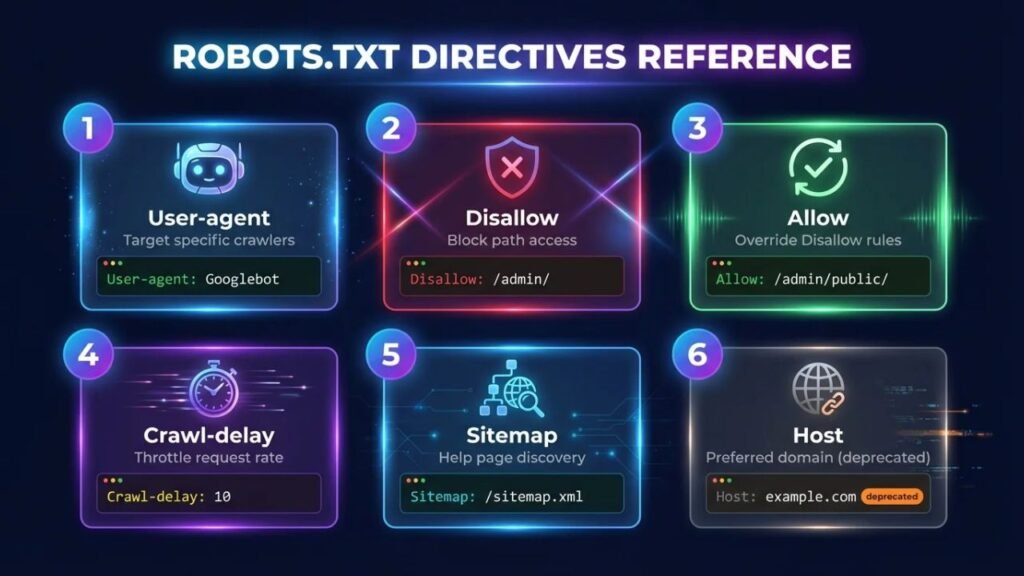
Common Directives Used in Robots.txt
| Directive | Purpose |
| Allow | Permits crawler access |
| Disallow | Restricts crawler access |
| Sitemap | Shows sitemap location |
| Crawl-delay | Controls crawl frequency |
| Clean-param | Ignores unnecessary URL parameters |
This structure helps search engines understand website priorities more efficiently.
Best Robots.txt Generator Tools for WordPress Users in 2026
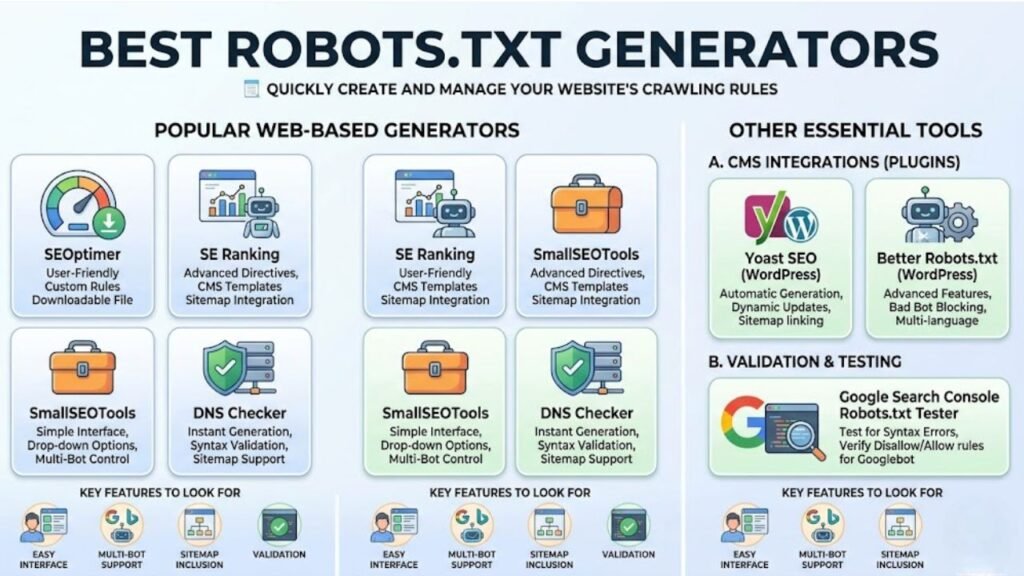
WordPress powers millions of websites, which explains why developers have created several robots.txt management tools specifically for the platform. Others provide some level of dedicated robots.txt features, and others do so as part of a more general SEO arsenal. The most suitable choice usually can be determined by the size of websites, the level of technical skills and your objective of SEO. The following tools are invariably discussed by the representatives of the SEO professional community as they enable easy management of files and minimise configuration errors.
Quick Comparison of Popular Tools
| Tool | Best For | Free Version |
| All In One SEO (AIOSEO) | Complete WordPress SEO management with advanced robots.txt editing | Yes |
| Google Search Console (GSC) | Testing, validating, and monitoring robots.txt files | Yes |
| Virtual Robots.txt | Lightweight virtual robots.txt management for WordPress | Yes |
| Better Robots.txt | Dedicated robots.txt optimization and crawler control | Yes |
| Rank Math | Users who want robots.txt management inside a full SEO suite | Yes |
| Yoast SEO | WordPress users looking for integrated SEO and robots.txt tools | Limited (Basic features) |
| Ryte | SEO professionals and agencies managing multiple websites | Yes |
| SEOptimer | Website owners who want SEO audits alongside robots.txt creation | Yes |
| Small SEO Tools | Beginners looking for a simple online robots.txt creator | Yes |
| Generate Robots.txt Files Spellmistake Tools | Finding syntax errors, typos, and formatting mistakes in robots.txt files | Yes |
Each tool approaches robots.txt management differently, which is why understanding their strengths matters.
1. AIOSEO Robots.txt Generator: Complete Control for WordPress Sites
AIOSEO is regarded by many of the SEO professionals as one of the most comprehensive WordPress SEO solutions. Besides the optimization of keywords and support of the schema, it features an efficient robots.txt editor. The editor enables one to design custom instructions without actions on server files. Consequently, new users can easily make adjustments, whilst the experienced users still have the full control.
An inbuilt validation system is one of the features. The tool identifies possible errors in configurations before saving the changes. This will minimize the possibility of blocking valuable pages on accident. Sitemap URLs are also automatically added by AIOSEO. Thus, search engines will be able to find new content more effectively.
2. Google Search Console for Robots.txt Testing and Validation
Google Search Console is not a conventional robots.txt generator; it is a significant element in dealing with robots.txt files. The owners of websites use it to verify that Google is able to access and comprehend their crawler directions accurately. Such an incident as the accidental blocking of a page is easily spotted with the help of Google Search Console in most cases. This renders it one of the most relied-upon tools in monitoring crawling behavior.
Updating robots.txt prompts many SEO professionals to review Search Console since the information can be presented using Google’s very own perspective. Users have access to real crawling feedback, not an inference based on whether a rule works or not. In websites relying on search traffic, such visibility can stop indexing problems and ensure valuable pages are available.
3. Virtual Robots.txt Plugin for Lightweight Website Management
Virtual Robots.txt offers a lightweight way to manage robots.txt instructions without creating a physical file on the server. The plugin creates a virtual robots.txt file using WordPress and does the majority of the technical labor by itself. Due to such a strategy, it is easy to use among a lot of bloggers and small web owners. The installation is easy and tends to involve a minimum of maintenance.
This resource is especially effective with those sites that require the basic crawler control and do not have complicated personalization. Search engines can be restricted at the discretion of users, without a clumsy WordPress setup. It is chosen by many since it does its job quietly in the background without causing unnecessary complexity.
4. Better Robots.txt Plugin for Advanced Crawler Control
Better Robots.txt enjoys total concentration on robots.txt optimization and crawler control. Whereas big SEO suites focus on assisting users to develop elaborate guidelines in search engines, this plug-in focuses on assisting users to create comprehensive guidelines for search engines. It is more lenient to those who own websites who desire a lot of control over how the crawling is conducted. This degree of customization usually comes in handy as websites increase.
It is highly user-friendly both to the beginner and advanced users as it eases the technical aspect, but still provides detailed options. Its transparency commonly suits e-commerce stores, content websites, and multilingual platforms. Many users appreciate the ability to create specific crawling rules without manually writing complicated code.
5. Rank Math Robots.txt Generator and SEO Management Tools
Rank Math includes a robots.txt editor as part of its broader SEO platform. A single dashboard enables website owners to control crawling instructions, sitemaps, schema settings and optimization work. This streamlines the working process as a user does not require more than one set of different technical SEO management tools. The settings are also kept organized by the integration.
Rank Math is popular among many affiliate marketers and niche site owners due to the fact that it integrates a number of tools used to perform various tasks related to SEO. Most websites are flexible enough with the robots.txt editor, which is also easy to use by non-technical people. After familiarizing themselves with the interface, the control of crawler instructions becomes easy.
6. Yoast SEO Robots.txt Editor for WordPress Websites
Yoast SEO remains one of the most recognized WordPress SEO plugins available today. Although most individuals are aware of it in terms of content optimization, it also enables users to control robots.txt files within the WordPress dashboard. This ease also eliminates the process of having to edit files by using hosting accounts. This means that web masters can inject more changes quicker and with more confidence.
The plug-in is particularly effective for users who are already using Yoast to undertake day-to-day SEO activities. This makes the overall management process feel geographically structured since the settings of robots.txt are next to the sitemap and indexing configurations. This simplicity is valued by many small businesses and bloggers as it minimizes the technical learning curve.
Bonus Robots.txt Generator Tools Available Online
Not every website runs on WordPress. Some website owners manage custom-built websites, ecommerce platforms, or systems that do not support WordPress plugins. In those situations, online robots.txt generators become practical alternatives. These tools typically generate robots.txt files through a web interface. Users create their directives online and then upload the completed file to their website.
7. Ryte Robots.txt Generator for Technical SEO Tasks
Ryte is widely known for technical SEO analysis, but its robots.txt generator also attracts attention from website owners who need precise control. The tool has a clean interface, and it assists the user in writing crawler instructions without necessarily possessing massive technical skills. It has become popular with many SEO professionals working with client websites because it can support more advanced configurations whilst being easy to use.
Ryte has one strength, such as emphasizing technical SEO best practices. Instead of just creating orders, it makes users consider how the search engines relate to their websites. In the case of agencies with numerous projects, Ryte is usually included in a wider scope of optimization as opposed to being a single solution.
8. SEOptimer Robots.txt Generator for Website Optimization
SEOptimer combines robots.txt generation with broader website auditing features. This combination makes it appealing to users who want more than a basic file creator. The platform enables the owners of the websites to create robots.txt instructions as well as examine technical SEO concerns that can influence the performance. This bigger view usually assists the user in recognizing connected issues that could otherwise not have been detected.
An acceptable robots.txt file may prevent a site from crawling efficiently, for example, sitemap problems, or indexing problems. SEOptimer enables the user to analyze different areas of technical SEO in one platform. This method can be helpful to small business owners since they do not have to acquire several individual tools to use.
9. Small SEO Tools Robots.txt Generator for Quick File Creation
Small SEO Tools offers a large collection of SEO utilities, including a simple robots.txt generator. The platform emphasises ease of access as compared to sophisticated personalisation. The tool is utilized by many beginners since it offers clear directions and direct options. The user is able to easily make a simple robots.txt file without having to worry about grasping technical details.
It is especially valuable with personal blogs, portfolio sites as well as small businesses that need not have comprehensive crawler management. Despite the fact that bigger websites might finally require more complicated solutions, Small SEO Tools is still a reasonable place of origin for users who need to set up their own robots.txt file.
10. Custom robots.txt generator for blogger: Common Errors and Fixes
Custom robots.txt generator for blogger appears surprisingly often in search results because website owners worry about syntax errors. That concern is justified. In contrast to most of the issues associated with websites, robots.txt is not very noticeable. Search engines are not always involved in warning and website owners might fail to realize something without a change in ranking or indexing patterns. Other typical errors are spelling errors, using the wrong folder paths, missing slashes and poorly formatted rules. A tiny error can change the way the search engines perceive the instructions.
By way of illustration, an online store may block a critical section of the store because of a misplaced character. The problem can go undetected for weeks and only start to result in traffic reduction. This is why so many owners of websites are dependent upon contemporary robots.txt tools. These platforms minimize chances of human error and assist to make sure that search engines are given the right instructions first.
Choosing the Best Robots.txt Generator for Your Website
Not every website requires the same solution. Small blogs often need simple controls, while large e-commerce stores benefit from advanced crawler management. If you use WordPress, AIOSEO and Rank Math provide the most complete feature sets. Meanwhile, Virtual Robots.txt works well for users who prefer a lightweight solution.
For Blogger websites, a custom robots.txt generator for Blogger can provide more flexibility than the default settings. Likewise, agencies managing multiple websites often prefer tools such as Ryte because they support broader technical SEO workflows. The best choice ultimately depends on your website size, technical knowledge, and long-term SEO goals.
Final Thoughts
The robots.txt file may seem small, yet it plays a surprisingly important role in technical SEO. Search engines rely on it to understand where they should spend their crawling resources. The file will be indexed much faster and the contents will be found much faster when it contains clear instructions. A good robots.txt generator will take a lot of the complexity of writing these files. It eliminates errors, makes updates easier and provides the owners of the website with more assurance in dealing with the crawlers. There are many websites that require a lot of time, whether your site is built on WordPress, represents an ecommerce portal, or is a Blogger site. A simple investment of time into the appropriate management of robots.txt can keep more significant SEO issues at bay in the future. The best approach is simple: choose a reliable tool, validate every change, and review your configuration whenever your website structure evolves.
Explore More Tools: