

The way people discover brands has changed a lot in recent years, and businesses now rely more on value-driven communication than direct promotion. The result of that change is why it is necessary to grasp what is content marketing and the role it plays in the growth of digital. Rather than disrupting a user with advertising, nowadays, brands capture attention by providing valuable and entertaining content that fulfills real questions. Furthermore, it is evident that customers in the contemporary world demand and seek transparency, relevance, and consistency whenever communicating with any brand in the digital world. They are not very responsive to aggressive selling but are fast responsive to assistive information. The reason behind this is that content strategies are centered on education, storytelling, and trust-building, as opposed to mere promotion.
This article will discuss such concepts as the definition of content marketing, various formats, developing the strategy, and real-life examples of content marketing. You will also learn how companies employ content to fuel growth and enhance visibility amidst a competitive world.
What Is Content Marketing?
The content marketing process starts with a simple concept, which is oriented to offering value to users. Organisations produce blogs, videos, and other online materials to educate, train and entertain, rather than sell directly. Such a practice is effective since individuals like the idea of learning and researching prior to decision-making. Moreover, the approach will assist brands in establishing long-term relationships as opposed to short-term conversions.
Users start to trust the source when they regularly get something that they find useful. This trust ultimately translates into sales and loyalty in the long-term. To give an example, a small startup publishing articles on its niche weekly can receive consistent traffic without having to spend a lot of funds on advertising. It consequently acquires visibility and credibility, yet in a natural manner.
Content Marketing Definition and Its Core Concept
The content marketing definition describes a process of crafting and sharing appropriate content that can be used by businesses to ensure that they appeal to a targeted audience. It is a procedure that encompasses planning, developing, publishing and evaluating content output to meet corporate objectives.
Moreover, content marketing is non-random. It has a clear flow with users initially discovering content, then interacting and finally acting. Such a trip assists companies in steering customers without coercing them to make decisions.
Content Journey Explained:
| Stage | User Intent | Content Example |
| Awareness | Learning | Blogs, videos |
| Consideration | Comparing | Case studies, guides |
| Decision | Buying | Reviews, testimonials |
Therefore, content becomes a bridge that connects curiosity with conversion in a natural way.
Types of Content Marketing Used by Modern Businesses
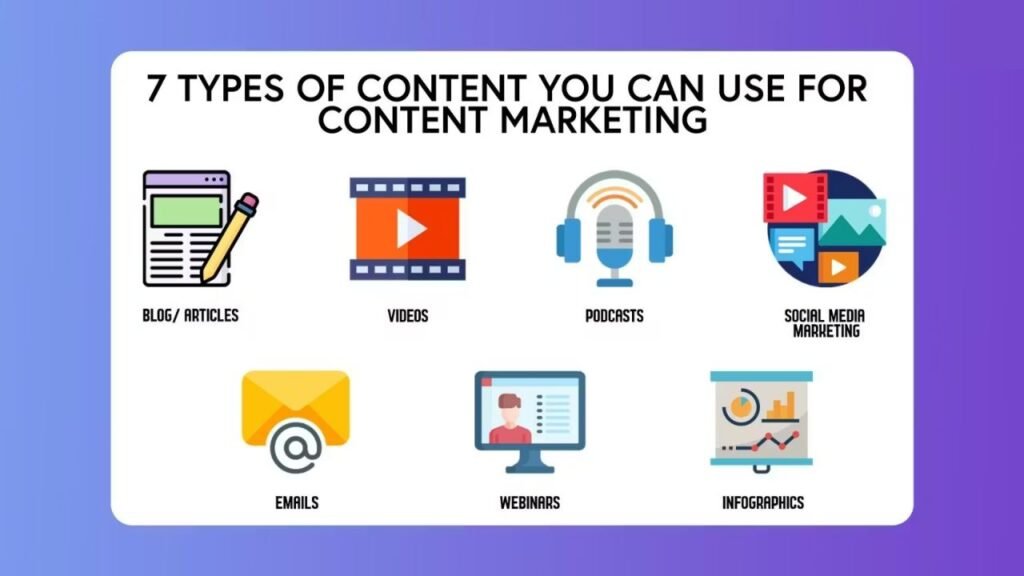
Modern businesses rely on multiple content formats to connect with audiences across different platforms and user preferences.
1. Blog Content for Organic Reach
Blogs also assist the brands to elaborate on issues and be visible on search engines. They respond to user queries and develop authority in the long term. Blog content written regularly will generate continuous traffic and be favourable in terms of long-term growth.
2. Video Content for Higher Engagement
Video content captures attention quickly and keeps users engaged for longer periods. It performs well on such platforms as YouTube and Instagram. Companies frequently rely on videos to either tell about products, provide a tutorial, or develop a more emotional bond.
3. Infographics for Quick Understanding
Infographics are a complex idea that comes in a simple form of visual representation. They are a mix of texts and designs to provide information within a short time. Therefore, users will be able to grasp important points without having to read lengthy material.
4. Social Media Content for Daily Interaction
Postings content on social media keep the brands in touch with their clients at least daily. They establish frequent physical interactions that enhance experience and memorability. This material also facilitates fast sign-ups and stylish communication.
5. Podcast Content for Storytelling
Through podcasts, brands have an opportunity to communicate knowledge and experience in a conversational manner. They forge a stronger relationship with listeners who are more of an audio content consumer. The format is practical when the discussion or the interview with the experts is in a long format.
Difference Between Content Marketing and Content Management
Some individuals mix content marketing and content management and they are used to fulfill different purposes of digital operations. The content marketing involves creating and publishing content which is valuable whereas content management involves organization and maintenance of the same content in an effective manner.
Also, content management systems enable companies to store, revise and post content without restriction by technical hindrance. These systems enable all the content to be organized and be at reach.
Consequently, the content marketing becomes an engagement driven by content and the content management an unhindered execution. The two collaborate in establishing a powerful digital presence.
Purpose of Content Marketing for Growth
Content marketing plays a key role in helping businesses grow by building trust and delivering consistent value to their audience.
1. Building Brand Awareness
The content promotes visibility as users are accessed on various platforms. As individuals tend to watch helpful videos every day, they start noticing the brand. This understanding breeds familiarity and trust in the long run.
2. Supporting Lead Generation
Content captures the interest of potential customers already interested in a subject. Businesses are helpful in guiding users to act by creating information they can use. This process improves lead generation through content and reduces dependence on aggressive selling.
3. Strengthening Customer Relationships
Content helps brands communicate with their audience in a meaningful way. It provides solutions to questions and problems, and this helps to strengthen relationships. This confidence results in customer loyalty in the long run.
4. Driving Website Traffic
Quality content enhances search engine results and leads to organic traffic. Consequently, a steady flow of traffic to businesses is achieved without necessarily depending on paid advertisements. This practice helps in sustainable growth.
5. Enhancing Customer Education
Content explains products, services, and solutions clearly. It assists users to be aware of value and make an informed decision. This clarity will lessen confusion and enhance the total customer experience.
How Content Marketing Works in the Digital Journey?
Developing content marketing as a guideline helps users move towards various decision-making phases. In the first process, users look and find information, then compare all the alternatives, after which they select a solution.
In addition, to cater to the needs of a particular stage, brands develop types of content at each stage. Combating this is a targeted method that enhances engagement and conversion.
Example Workflow
| Step | Action Taken |
| Research | User searches topic |
| Engagement | Reads blog or watches video |
| Decision | Chooses a product |
Therefore, content marketing is transformed into a process of attracting, engaging, and converting users into a cycle.
Content Strategy and Its Role in Success
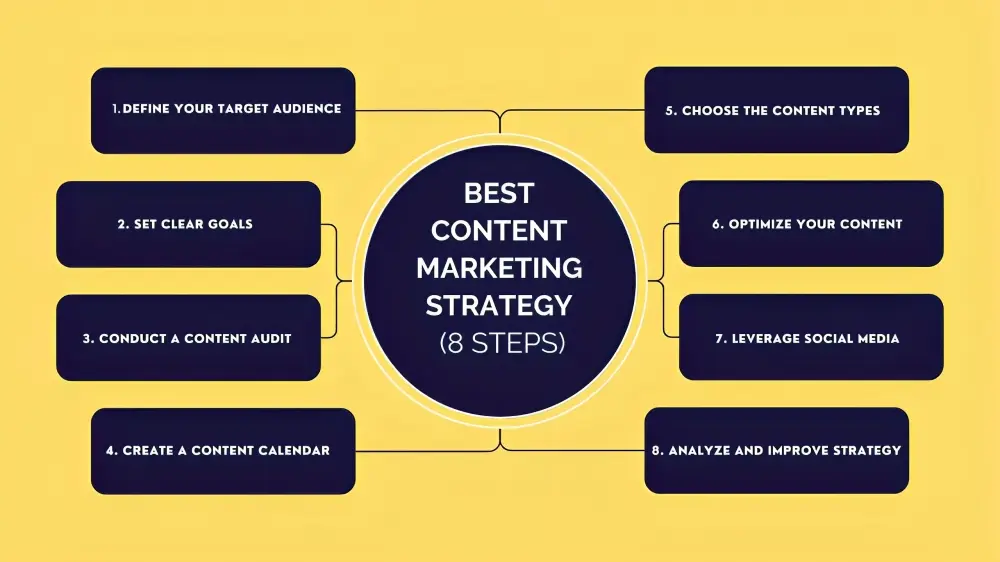
A powerful plan links the activities of contents and the objectives of business. Content will not provide consistent results without planning. Thus, companies need to synchronize the content production with the needs of the audience and market trends.
Key Strategy Elements
- Clear goals
- Audience research
- Content planning
- Performance tracking
Additionally, a content strategy involves scheduling content, formats, publication dates, and performance measures. This well-organised way illustrates clear and consistent. Consequently, this will allow businesses to develop meaningful content that spurs growth that can be measured.
Steps to Build an Effective Content Marketing Plan
A structured plan ensures that content efforts remain focused and aligned with business goals.
Step 1: Setting Clear Goals
Each plan starts with the development of clear and measurable goals. The businesses have the choice of either traffic, leads, or brand awareness. Animated objectives present a sense of direction and a way of gauging success.
Step 2: Understanding the Target Audience
The awareness of the audience assists in the development of effective and interesting materials. Businesses ought to learn user behavior, preferences and problems. Such an insight guarantees that the content addresses actual needs.
Step 3: Choosing the Right Content Types
Choosing appropriate formats enhances the effectiveness in content. The purpose of blogs, videos and social media posts is different. The formats used by businesses should depend on preferences of the audience.
Step 4: Creating a Content Calendar
The solution to this issue is a content calendar, which assists in consistency in publication. It arranges subjects and deadlines and schedules in a systematic manner. This would facilitate frequent delivery of content.
Step 5: Measuring Performance and Improving
Follow-up of the performance assists in determining what is working and what requires further enhancement. The metrics that businesses ought to use are such as traffic, engagement, and conversions. Constant upgrading results in a high level of performance.
Content Marketing Platforms and Tools Explained
There are many tools that businesses apply to cope with the content. These applications make it easy to plan, design and distribute content among various platforms. A content marketing platform assists teams in cooperation and workflow optimization. Meanwhile, publications and updates are easily published and updated with content management systems. Further, analytic tools are useful in the measurement of performance and optimization of strategies. These tools will make sure that there are effective content efforts that are goal-oriented.
Role of Content Marketing in B2B and B2C
Content marketing works differently for B2B and B2C audiences, but the core idea remains the same. B2B is more logical and informative whereas B2C is based on emotional appeal and narrative.
Nevertheless, these two methods also focus on developing mistrust and leading the users into choices. Depending on the type of audience; the businesses adjust their content style.
Comparison of b2b and b2c
| Factor | B2B Approach | B2C Approach |
| Focus | Logic | Emotion |
| Content | Reports | Stories |
| Goal | Lead generation | Engagement |
Interestingly, B2B content now adopts storytelling techniques similar to B2C to improve engagement.
Evolution of Content Marketing in 2026
Internet space is volatile and content marketing keeps pace with the transformations. The users are now in search of customized and sensitive communication that meets their needs. In addition, mobiles have increased tremendously in use, and, as such, mobile-portable content is a necessity. Video content also keeps on increasing because of its incredible engagement levels. Further, companies are more concerned with quality, than with quantity. They focus on quality and impactful content as opposed to the frequent publication of quality content.
Content Marketing for Beginners and Practical Insights
For beginners, content marketing may seem complex, but it becomes simple with the right approach. Begin with learning to know your audience and audience needs. Next, produce information that is straightforward to their queries. Additionally, consistency is a key factor that contributes to success. Regular publication of content can be used to build trust and enhance visibility with time. The approach geared towards clarifying, relevance, and simplicity instead of complexity is aimed at a beginner-friendly approach. This makes the content accessible and effective.
Conclusion
The best way of content marketing is by being helpful to others and selling later. When you understand what is content marketing, you start creating useful content that builds trust over time. This will make your audience identify with your brand in a natural manner. In addition, regular content enhances publicity, builds authority, and long-term development without depending solely on advertising.
Meanwhile, it is always good to be consistent and be able to follow fads. With the use of the appropriate strategy, appropriate formats, and consideration of the needs of users, the results become almost constant. So, maintain minimalist, straightforward and useful content to ensure that it remains appealing and engaging to the appropriate audience.