
Social media is no longer just about posting content and hoping for engagement. Today, platforms act like search engines, and users expect value in every scroll. As such, brands have to reconsider their methods of visibility, engagement, and conversions. A good Social Media Marketing Strategy will make you stay focused, consistent and result oriented. It bridges the gap between what you post and what you intend to achieve with your business as well as making sure that your audience find you at the appropriate opportune time. Additionally, it has eliminated conjectures and given way to clarity and intent.
In this detailed article, you will learn how strategies have evolved, how AI improves execution, and how businesses can scale efficiently. Furthermore, we will discuss influencer partnerships, content strategizing, and tracking performance. It will leave you with a roadmap of clearly how to use in the upcoming years to 2026 to build a strategy that would work.
About Social Media Marketing Strategy
A Social Media Marketing Strategy is the backbone of any successful online presence today. Not only is it about posting content frequently, but also creating a clear direction that will lead your brand to the right audience. Business enterprises are directed by a systematic approach and thus they understand what to post, when and why each step is significant. Content is therefore more meaningful and the performance is then enhanced as time goes by.
Additionally, a clear Social Media Marketing Strategy can assist brands to be consistent through the platforms. Businesses need not find its way in the dark when it comes to experimenting but rather focus on content that is in line with their objectives. It is also a strategy which ensures that everything is contributing to brand awareness, activity or conversions. Thus, strategy is important to long-term success, and not short-term visibility.
Social Media Marketing Strategy 2026: Adapting to Platform Evolution
Social Media Marketing Strategy focuses on adapting to rapid changes in user behavior and platform algorithms. Direct search has been introduced in social applications and this implies that the content should be optimized so that it can be discovered. As a result, captions, keywords and type of videos are significant.
Additionally, platforms have shifted the focus to engagement indicators such as saves, shares, and watch time. Thus, brands need to produce content that promotes interaction as opposed to scrolling. As an example, videos and informative materials do better compared to the non-place-value posts.
Key Changes in 2026
| Trend | Impact |
| Social search | Users discover content inside apps |
| Video-first approach | Higher engagement rates |
| AI integration | Faster and smarter execution |
In addition, understanding social media trends helps brands stay competitive. When you adapt quickly, your content remains relevant and effective.
Social media strategy for businesses: Connecting Content with Results
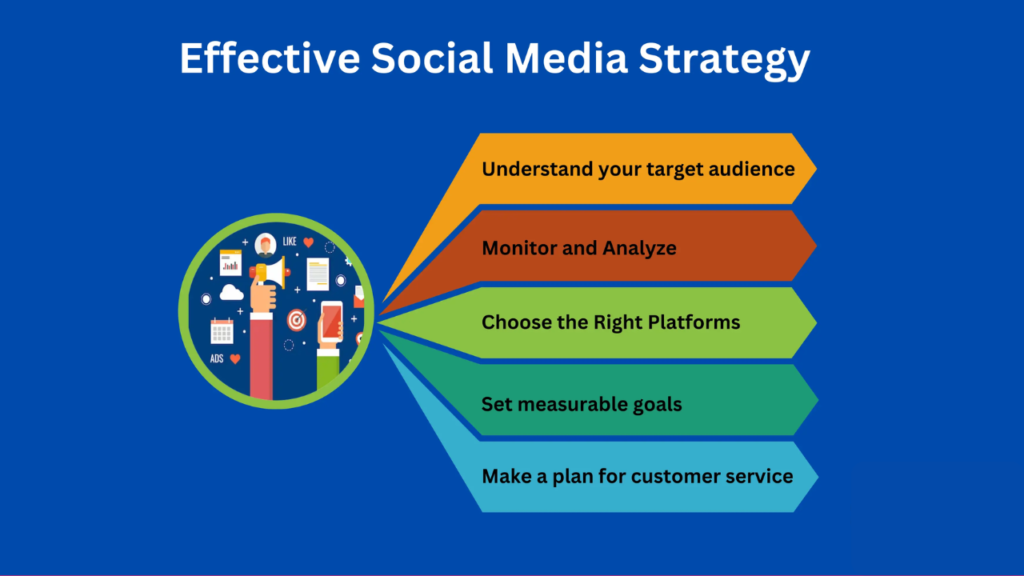
A Social media strategy for businesses must align content with measurable outcomes. Businesses should not target likes or followers but lead and convert, and retain. Hence, every post should be in support of a certain purpose.
Also, content and goal alignment guarantees consistency. An example is that a company that is oriented towards creating inquiries can be a service-based company and an eCommerce brand aims at making direct sales. Consequently, the plan will be more efficient.
Business Goals and Content Types
| Goal | Content Approach |
| Awareness | Reels, trending content |
| Leads | Educational posts |
| Sales | Product showcases |
| Engagement | Interactive content |
Moreover, clarity in goals improves decision-making. When teams understand their priorities, they create more impactful content.
Influencer marketing strategy: Leveraging Trust for Growth
The influencer marketing approach aims at earning trust by developing genuine partnerships. They trust creators who are able to highlight their personal experiences and not miskegenies. This implies that the brands must aim to work with influencers who can impact their values and followers.
Also, micro-influencers are more interactive as they are more associated with their followers. We can use the case of relatively small maker reviewing a product being much more efficient in purchasing decision making as compared to a celebrity endorsement.
Steps to Build an Influencer Strategy
- Identify relevant creators
- Analyze engagement rates
- Focus on authenticity
- Build long-term partnerships
Additionally, this approach increases credibility. When audiences trust the message, they respond positively and take action.
AI in social media marketing: Transforming Content and Analytics
Artificial intelligence has changed how brands create, publish, and analyze content across platforms. It assists marketers to make decisions more quickly besides enhancing the accuracy of the decisions. Due to this, companies are able to dedicate more time to creativity and strategy, rather than on routines.
1. Content creation automation and idea generation
AI tools are used to create captions and post ideas amongst other video scripts that are generated based on trends and audience behavior. This assistance saves on the amount of time taken on brainstorming without yet compromising on uniformity of the message. Besides, marketers will not need to begin anew with other formats.
2. Audience behavior analysis and predictive insights
Artificial intelligence analyzes user behavior, such as likes, shares, and watch time, to inform the creation of better type of content. Thus, brands will be able to make informed decisions, rather than using merely guesswork. This will enhance participation and deliver content to the appropriate audience.
3. Automated engagement and response systems
Chatbots, and automated responses assist companies in responding promptly to remarks and messages. This immediate communication enhances customer satisfaction and trust in the long run. Also, it enables anything to allow teams to manage high-numbers of queries within a given time without delay.
4. Performance tracking and optimization
Dashboards based on AI can provide a visualization of campaign performance to a greater depth. These tools are used to pinpoint areas of strengths and weaknesses and refining strategies is easier. As a result, companies are able to enhance performance by doing what is most successful.
How to grow on social media: Data-Driven Growth Strategy
Expansion in social platforms requires persistence, examination, and constant enhancement. Businesses should not rely on random posting but rather have a designed strategy that emphasizes on performance data. This approach guarantees the long-term consistent and predictable development.
1. Consistent content publishing and scheduling
A consistent posting timetable will keep the audience interested and familiarize them with the brand. Consistency is also a pointer of reliability to platform algorithms and can enhance visibility. Hence, it is necessary to plan the content beforehand to achieve success over time.
2. Analyzing performance metrics regularly
The engagement, reach, and conversions monitoring can help in identification of what contents are performing well. Reexamining such metrics every week, the businesses will have the opportunity to learn more about the audience preferences. Consequently, they are in a position to concentrate on those strategies that are more effective.
3. Optimizing high-performing content formats
The brands should focus on those formats, like videos or carousels, that create more engagement. The method brings about maximum results with minimum effort. Besides, it is better to refine the effective content to enhance the general efficiency.
4. Engaging actively with the audience
The replies to messages and comments help to develop better relationships with adherents. Participatory activity promotes deliberations and enhances exposure. As a result, brands build a fan base that is conducive to sustainable development.
Planning social media content: Creating Consistency and Value
Social media content planning makes certain that your content is well structured and effective. Brands may deactivate inconsistency and ambiguity with a lack of planning. Hence, an effective plan assists in avoiding quality and focus.
Furthermore, knowing what is a content calendar is would be useful to plan posts optimally. A content calendar enables you to pre-plan content, formats and even dates. Consequently, the teams are able to implement strategies without huddles.
Content Planning Essentials
- Define content pillars
- Maintain consistency
- Balance trends and evergreen topics
Furthermore, effective social media content planning improves engagement. When content aligns with audience needs, it delivers better performance.
Paid social media advertising: Scaling Reach and Conversions

Paid campaigns have become essential because organic reach alone often limits visibility. Brands that are carefully invested enable them to get to the right people in less time and enhance a chance of conversion. Additionally, the paid campaigns would complement the organic ones by making content that is already doing well higher. This means that companies are able to expand without necessarily having to depend on the sluggish organic developments.
1. Expanding audience reach with targeted campaigns
Precise campaigns assist brands to communicate to certain group of users depending on the interest and the behavior engaged. Businesses concentrate on those who can more likely interact rather than displaying ads to everyone. Thus, targeting is efficiency and spend reduction. It is also a strategy that makes the consideration of the content and audience expectations closer.
2. Improving conversions through optimized creatives
Effective creatives also contribute significantly to enhance conversions. Natural and relatable ads tend to be more effective than over-polished ads. Moreover, well-articulated messages and good hooks are eye catching. Thus, the users will be more inclined to click, browse, and make an action.
3. Balancing organic and paid strategies
A strategy incorporating both organic and paid campaigns is a balanced strategy. Organic posts are credible and trusted, whereas paid advertisements are more opportunities and lots of exposure. Consequently, companies ought to carry out viral testing on content and then put it on a large scale using advertisements. This is an effective way of improving the results but at low cost.
4. Measuring return on investment for better decisions
Monitoring performance assists the business in knowing what is performing well and what needs the adjustment. Such measures as click-through rate and conversions are important. This leads to continuous optimization of campaigns by the brands and higher returns.
Social media marketing goals and KPIs: Measuring Real Success
Setting social media marketing goals and KPIs will make sure that your work is focused and quantifiable. Performance cannot be easily assessed in the absence of explicit metrics. Thus, it is important to monitor the appropriate indicators.
Also, it is effective to work on meaningful metrics to prevent distractions. Rather than pursuing likes, brands are to quantify conversions and engagement. Therefore, they are able to make improved decisions.
Important KPIs
- Engagement rate
- Conversion rate
- ROI
Moreover, tracking brings about a continuous improvement. By tracking performance, businesses optimize their strategies when it is continuously tracked.
Conclusion
A powerful Social Media Marketing Strategy is no longer optional in 2026, as competition continues to grow across platforms. Companies that calculate and act on the plan hold a clear edge over the ones which are random about posting. Concentrating on strategy thus would mean that all efforts are geared towards significant outcomes and sustainable development.
Moreover, social media success will require learning the trends, effective utilization of tools and genuine engagement. The combination of these factors when, accompanied by a well-thought-out strategy, the brands form a strong presence will allow them to create a strong impact to draw and retain audiences. Consequently, social media will cease to form a marketing channel instead, social media will be a source of business expansion.
Finally, a planned Social Media Marketing Plan will assist the businesses to move forward in a systematic, and confident way. By taking care of uniformity and fact-based choices, it should deliver sustainable development and measurable triumph on the evolving digital landscape.
Read Our More Blogs & Learn More :- What is SEO Marketing: How To Rank #1 on Google