
The way of search has transformed over the past years and people now demand more than information as they seek answers that they can rely on. Therefore, At the same time, search engines have also evolved to be smart not giving precedence to content according to keywords or links but also according to credibility and usefulness. This changed Google E-E-A-T to be among the most significant concepts to a working person in the field of SEO, content writing or digital marketing.
Through this article, you will definitely learn what this notion is about and how it relates to ranking, trust, and AI-driven outcomes. You will also consider effective tactics, real-life cases, and organized knowledge that assist you in developing a long-term authority. Besides, various issues such as What is E-E-A-T in SEO, E-E-A-T guidelines that Google uses, and How to improve E-E-A-T with proven techniques will be discussed.
What is E-E-A-T in SEO?
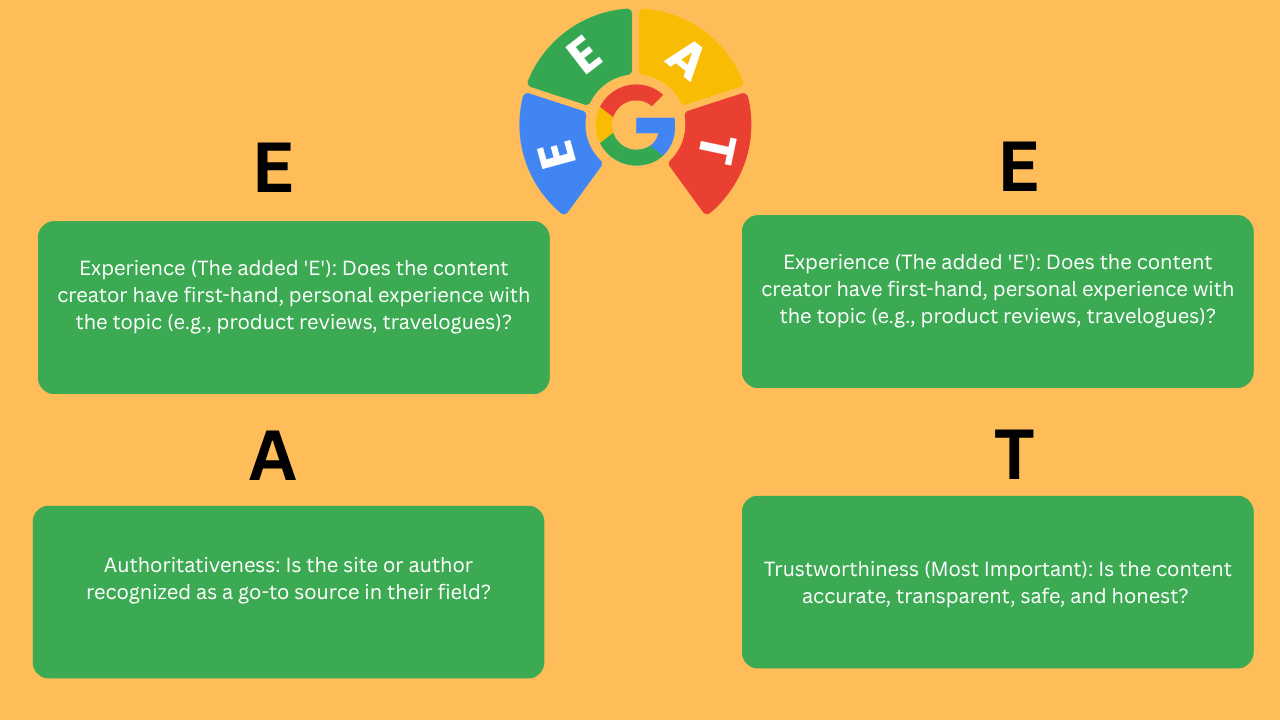
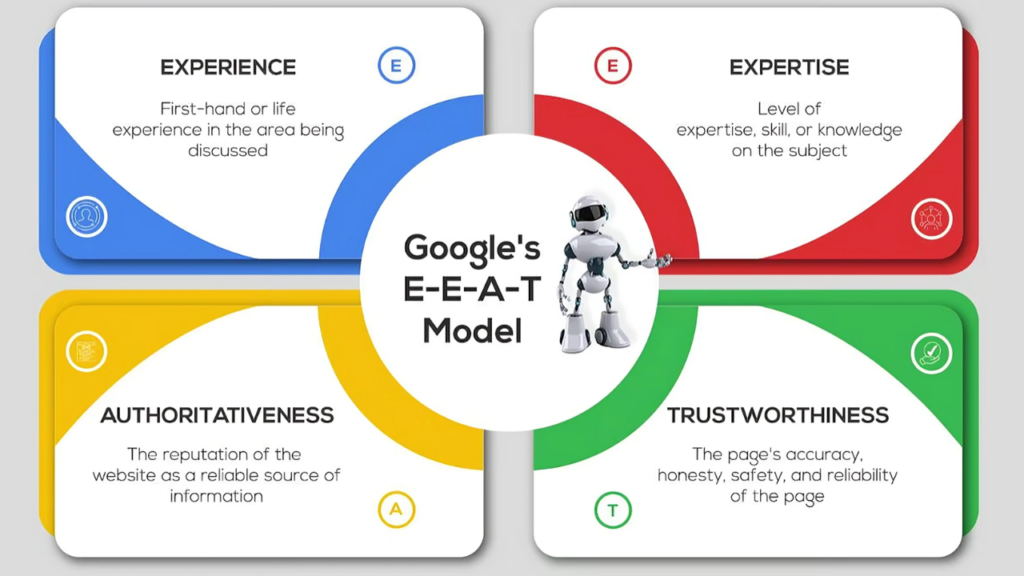
E-E-A-T in SEO requires looking beyond definitions because it is more about intent and credibility than just technical rules. This framework is used by Google to analyze the usefulness of the content and the fact whether the person who makes it has a real experience and/or even knows this subject. Put simply, it can be translated into experience, expertise, authoritativeness, and trustworthiness, which is meaningful in quality content.
Additionally, this idea assists Google in sifting out low-quality or generic results and will encourage pages that depict actual wisdom and trustworthiness. As an illustration, when a person writes a review of a product out of real-life utilization, he demonstrates his experience, whereas a specialist may explain financial tips out of his expertise. The more prominent such signals, then, the better the content will fare in search results and have long-term presence.
Core Components of E-E-A-T
| Component | Explanation | Example |
| Experience | Real-world involvement | Using and reviewing a tool |
| Expertise | Skill or knowledge level | Certified professional advice |
| Authority | Industry recognition | Mentions on trusted platforms |
| Trust | Accuracy and safety | Verified and updated content |
This structure demonstrates that quality content does not merely relate to writing but also relates to credibility. Consequently, establishing trust should always be the main focus.
E-E-A-T Guidelines Google Uses to Evaluate Content
When discussing the E-E-A-T guidelines that Google applies, it becomes clear that the search engine relies on both human judgment and algorithmic knowledge. Google employs quality raters who test the fulfillment of the user expectations of the content and the sign of true expertise and reliability. Even though these ratings do not directly alter the rankings, they condition the system to learn over time what quality content is.
Moreover, Google examines on-page and off-page signals to know who is credible. On the one hand, it verifies the structure of content, its clarity, and accuracy, and on the other hand, it verifies the use of links, mentions of the brand, and its reputation in general. This makes websites with consistent availability of reliable information and a positive reputation visible.
Key Signals Evaluated by Google
| Signal Type | Details |
| On-page signals | Author bio, content depth, accuracy |
| Off-page signals | Backlinks, reviews, mentions |
| Technical signals | Site security, usability |
Moreover, entity recognition is also employed by Google and this is the reason why your content is related to the familiar issues, figures or brands. So when the information is shown on the same platform on a regular basis, today, it gives your word more strength and makes the entire information more reliable.
E-E-A-T vs SEO Ranking Factors and Their Real Difference
Most people tend to draw comparisons between E-E-A-T vs SEO ranking factors yet some knowledge about their differences aids in creating a superior strategy. Traditional SEO is based on quantifiable factors like the use of keywords, backlinks and page speed but the E-E-A-T depends on the use of credibility, reputation and trust. Their differences in determining the performance in search are different despite the fact that they work together.
Comparison Overview
| Aspect | SEO Ranking Factors | E-E-A-T |
| Focus | Optimization | Trust and authority |
| Approach | Technical improvements | Reputation building |
| Result | Short-term ranking | Long-term growth |
This comparison proves that although SEO methods make them visible, trust makes them stable and successful in the long run. As an example, a page can temporarily be ranked highly, though with good backlinks, but without trust, the page might not be able to maintain its ranking. Conversely, a site that earns the trust of the user will accrue organic links, interaction and brand awareness. Hence, E-E-A-T is similarly a pillar that reinforces traditional rating aspects.
How to Improve E-E-A-T with Practical and Real Methods?
When focusing on improving E-E-A-T, one needs to realize that little consistent steps generate robust outcomes in the long-run. To begin with, producing content with the help of real experience is powerful as it contributes certain originality and value. Rather than re-writing the content, exchanging knowledge, examples, and individual findings enhances credibility boosts far more.
Second, an emphasis on expertise in terms of author profiles, credentials, and expert reviews earns both the user and search engines more trust. Additionally, regularly updating the content will make sure that information remains correct and applicable and contribute to the further enhancement of reliability.
Practical Steps to Improve E-E-A-T
- Add clear author details with experience and background
- Include expert opinions and real case examples
- Maintain consistency across platforms
- Update content regularly to keep it fresh
In addition, it is better to build relationships, and accolades by some trusted people enhance authority. Thus, there should be regular work on both content and branding to generate better outcomes.
E-E-A-T in AI Search and Its Expanding Role
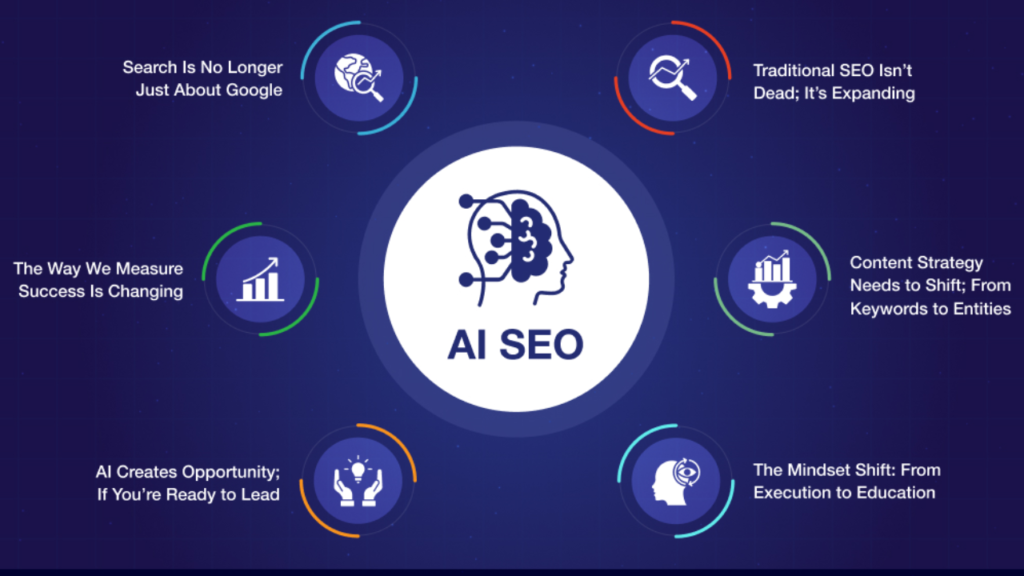
The rise of AI-dedicated search engines has altered the process of content discovery as they no longer provide additional links listed in the search results but rather display answers. Consequently, the content having consistency, credibility, and clarity becomes more prominent among AI-generated answers.
How AI Systems Prioritize Credible Information
AI systems analyze content according to its reliability and structure on a variety of platforms. They evaluate how the information matches known entities and whether you get the same information about it in multiple sources. Thus, often clear and accurate content is chosen more often in AI-generated responses.
Importance of Brand Mentions and Sentiment
Credibility is reinforced by positive references in all types of forums, reviews and communities. Users refer to a brand naturally, which generates indicators that the AI system can perceive as trust in the real world. Moreover, continuous positive emotion aids content to be more visible in time.
Role of Structured Content in AI Visibility
Headings, clear formatting, and rational use of logical flow assist the AI systems in comprehending information more quickly. When the content adheres to a systematic format, it becomes more likely to mask and display the essentials with algorithms. Therefore, structured writing enhances readability and discoverability.
Impact of Consistency Across Platforms
Consistency in messaging across websites, social networks, and outside platforms creates a greater acknowledgement. When this information is presented in more than one source, this contributes to reliability. Thus, it becomes necessary to be consistent to be visible in the long-term.
Building Strong Trust Signals for Long-Term Growth
Trust cannot be achieved overnight and it is built over time through hard work and openness. Websites whose design is user-friendly, secure and clear tend to receive a greater degree of trust in the long run. As an example, a secure HTTPS connection and clear contact information right off are credibility boosters at a glance.
Added to this, the inclusion of pages like the About, Privacy Policy, and Terms of Service displays professionalism and reliability. These factors might not be very complex, but contribute significantly to the establishment of confidence in the user and the enhancement of the sense.
Essential Trust Elements
| Element | Purpose |
| HTTPS security | Ensures safe browsing |
| Contact details | Builds transparency |
| Policies | Shows professionalism |
Moreover, functional navigation and neat design help in enhancing user experience. Thus, the ability to integrate technical quality and straightforward communication will build overall trust.
Common Mistakes That Reduce Content Credibility
Most websites fail to have visibility due to unknowingly diminishing their credibility by making preventable errors. Such problems tend to deter trust and constrain its eventual growth, despite other growth optimization initiatives being healthy.
1. Publishing Repetitive or Low-Value Content
Repeating other content over and over again is unhelpful to users because it does not provide any new value. It is common knowledge that readers anticipate exclusive opinions and they are swamped by them easily when they fail to do so. Thus, originality is important for credibility.
2. Lack of Author Transparency
The absence of content concerning the situation in terms of the creator or their background leaves doubts. Users would like to know who authored the information they are reading. Due to this, the loss of author information can decrease credibility dramatically.
3. Misleading Headlines and Overpromises
User negative experiences are caused by titles that exaggerate or misrepresent. Such headlines might get clicks in the short term, but undermine credibility over the long term. Thus, it is necessary to adhere to integrity when communicating.
4. Ignoring Content Updates and Accuracy
Outdated information reduces reliability, especially in fast-changing topics. Frequent updates make the content relevant and useful to readers. Therefore, the element of being fresh becomes significant.
5. Poor User Experience and Excessive Distractions
Websites filled with ads or confusing layouts create frustration for users. When navigation becomes difficult, users tend to leave quickly. Therefore, a clean and simple design supports better engagement.
Role of E-E-A-T in Sensitive Topics and YMYL Content
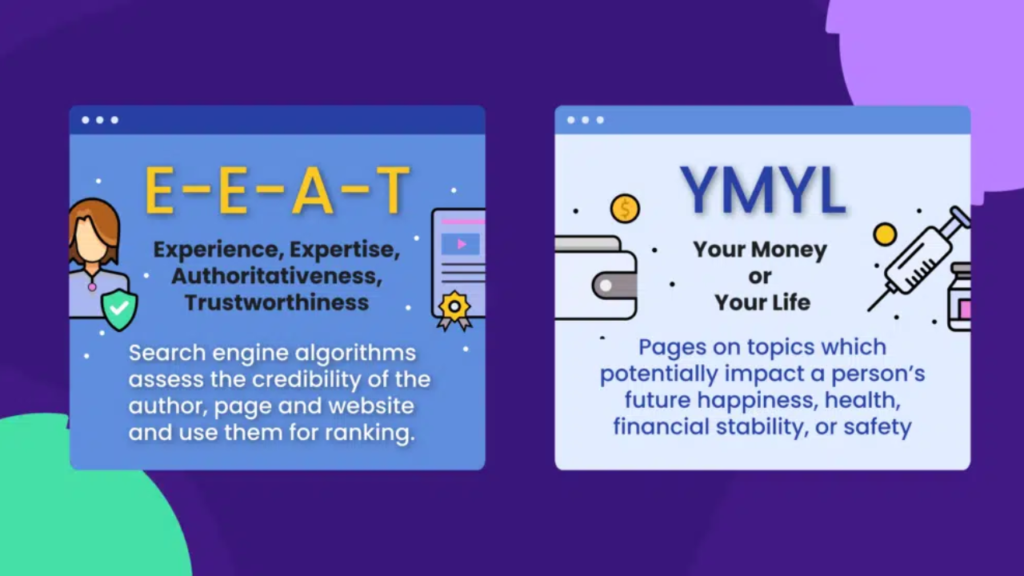
E-E-A-T becomes much more important when it comes to issues that have a health, financial, or even safety concern. Such content can also be called the YMYL content, when the factors of accuracy and trust become crucial. Verified information and expert advice play a significant role in such instances.
This is why the content creators need to make sure that the information is correct, researched and based on credible sources. Furthermore, there should be credible author details and professional knowledge in these fields.
Why E-E-A-T Matters More in YMYL
- It protects users from misinformation
- It ensures reliable decision-making
- It improves overall trust in content
Consequently, more credibility signals are necessary with such subjects than with general material.
Conclusion: Why Google E-E-A-T Defines Modern SEO Success
Search engines continue to evolve, and trust has become the most valuable factor in content ranking. Google E-E-A-T is at the middle of the stage of deciding whether or not your material is worthy of attention and credit. As such, prioritizing real experience, authority building, and transparency will never go wrong. In addition, with the ongoing growth of AI search, credibility will soon be emphasized even more in terms of visibility. Therefore, persistence, honesty and effective communication are going to get you through the rough.
Read Our Other Blogs to Learn About More Topics:
FAQs
Q1. What is YMYL content and why does it matter for E-E-A-T?
Ans. YMYL (Your Money or Your Life) topics are those that have a direct impact on an individual’s life, health, finances, or safety.
Some Examples:
- Finance
- Health
- Legal Advice
- News
If incorrect information is provided regarding these topics, it can cause harm to people.
Therefore, Google places great emphasis on E-E-A-T (Experience, Expertise, Authoritativeness, and Trust) for such content.
Q2. Can E-E-A-T be faked?
Ans. No, E-E-A-T is entirely based on genuine trust and reputation. You can claim anything on your website, but Google also looks at:
- Do other credible websites recognize you?
- What is your online reputation like?
Therefore, it is not possible to fake E-E-A-T.
Q3. Is there a tool that can measure E-E-A-T?
Ans. No, there is no tool that can directly provide an E-E-A-T score. Because It is not a single metric. Rather, it is a combination of various signals.
However, you can gauge it through certain indicators:
- Backlinks
- Brand mentions
- Author credibility
The best approach is to understand Google’s Quality Guidelines and optimize your content accordingly.
Q4. How does E-E-A-T apply to User-Generated Content (UGC)?
Ans. User-Generated Content includes:
- Comments
- Reviews
- Forum posts
E-E-A-T applies to these as well, though the application is somewhat more flexible.
Key Points:
- Each piece of content is evaluated individually
- Moderation (oversight) is essential
If your website contains:
- Excessive spam
- Inaccurate or objectionable information
Then your website’s trustworthiness is diminished.
Q5. What mistakes should you avoid in E-E-A-T?
Ans. Many people commit this mistake unknowingly:
- Fake author profiles
- Do not give proof of real expertise
- Publish generic or copied content
- Contact information missing hona
- Don’t cite sources.
- Outdated articles
- Weak brand identity
Q6. Why is E-E-A-T important beyond Google (in the AI era)?
Ans. Today, Google ranking isn’t the only game in town. AI tools and search platforms also Prefer trusted sources And Verify author credibility.
This means:
If your E-E-A-T is strong, you will:
- Rank in search results
- Appear in AI-generated answers