
The browser address bar is something that you almost certainly use hundreds of times a week without giving a second thought. You enter Chrome, enter and press Enter and move on. Nevertheless, it is with a small bar at the top of the screen that you control nearly your whole web experience. It decides whether to open a website directly, perform a Google search, suggest pages from your history, or even predict where you want to go next. When opening a new browser tab, the phrase “search or type web address” will be the first thing most users see. Some think it is only a placeholder text. Others assume it belongs to Google. The reality is far more interesting because modern browsers built this feature to simplify internet navigation completely. Instead of giving users separate boxes for search and URLs, browsers merged everything into one intelligent field.
The system feels simple from the outside, yet several smart processes run in the background every second. Browsers study patterns, browsing habits, URL structures, and user intent instantly. That is why the address bar feels fast and smooth even when millions of websites exist online. Once you understand how this feature works, browsing becomes quicker, safer, and much less frustrating.
About “search or type web address”
Search or type web address appears in the browser address bar because modern browsers combine two actions into one smart field. You can either search the internet using keywords or open a website directly by typing its URL. Chrome, Firefox, Edge, and Safari all follow this system because users prefer a cleaner and faster browsing experience.
Earlier browsers used separate search boxes and URL bars. That setup confused many people because they had to decide where to type every time they opened a webpage. Browser companies later simplified everything by merging both functions into one intelligent bar. That small change made internet browsing much smoother for everyday users.
When someone types “best mobile phones under 30000,” the browser performs a search. When someone types “youtube.com,” the browser opens the website directly. The browser understands the difference automatically by studying patterns inside the text.
Examples of How Browsers Respond
| User Input | Browser Action |
| netflix.com | Opens website |
| best gaming keyboard | Performs search |
| Usually searches | |
| gmail.com | Opens Gmail |
The search or type web address system works quietly in the background, yet it controls almost every browsing action users perform online.
What Is a URL?
A URL is an abbreviation of Uniform Resource Locator. Put simply, it is the entire address of an online resource or a webpage. Each webpage, article, picture or file on the internet has a URL. The browser knows where to go when users enter a web address into the address bar (type in a URL) or search. It takes one right to the requested webpage without displaying search results in the first place. That process feels instant because browsers handle the technical communication automatically.
A URL may look complicated initially, although each section has a simple purpose. The protocol handles secure connections, the domain identifies the website, and the path points toward a specific page.
Basic Parts of a URL
| URL Section | Example | Purpose |
| Protocol | https:// | Secure connection |
| Domain | google.com | Website name |
| Path | /blog | Specific page |
| Parameter | ?id=10 | Extra information |
For example, typing https://www.example.com/blog tells the browser exactly which webpage should open. Most users only notice the domain name, yet the full URL structure matters heavily for browsing speed, security, and SEO.
Why Modern Browsers Show “Search or Type web address”
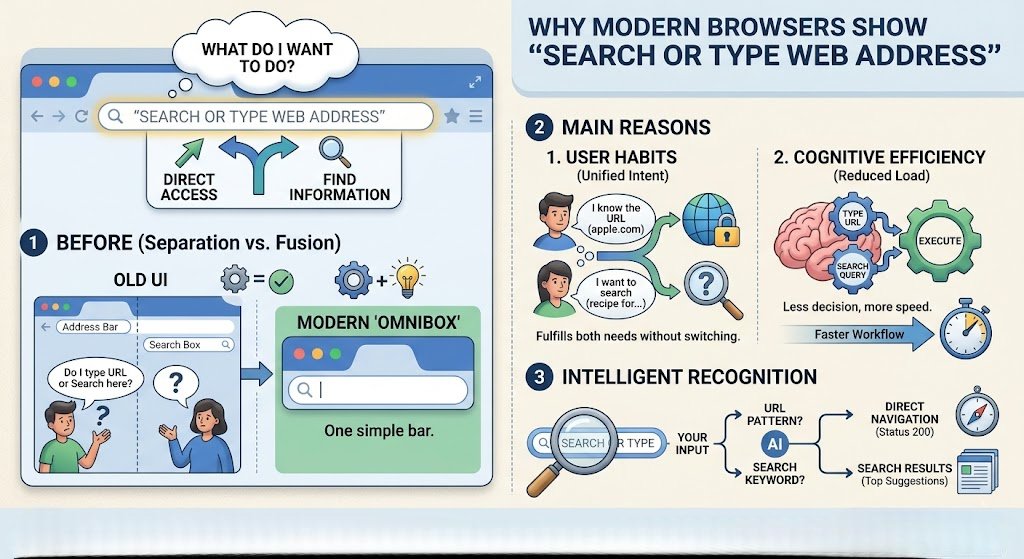
Modern browsers display the phrase search or type web address because they want users to understand the dual purpose of the address bar. The browser essentially tells users that one box handles both searching and direct website navigation. Browser developers noticed that separate search fields created unnecessary confusion. Many users accidentally searched URLs or typed questions into the wrong field. Combining both actions removed that extra complexity completely.
The address bar now behaves like a smart assistant. It predicts websites, remembers browsing habits, and recommends searches while users type. This design feels simple on the surface, although several advanced systems work in the background continuously.
Why Browsers Prefer a Unified Address Bar
- Faster browsing experience
- Cleaner browser design
- Better mobile usability
- Easier navigation for beginners
- Smarter autocomplete predictions
Most people never think about these improvements because modern browsers make the process feel natural automatically.
How Browsers Understand Search Intent vs Website Navigation
Browsers use prediction systems and pattern recognition to understand user intent. When someone types inside the search or type web address field, the browser checks whether the input resembles a website address or a search query.
Single-word entries often create confusion. For example, typing “amazon” may trigger a search because the browser cannot confirm whether the user wants Amazon’s website or information related to the company. Typing “amazon.com” removes the confusion immediately.
Browsers also study browsing history, bookmarks, and frequently visited websites. That is why suggestions improve over time and feel more accurate during daily browsing.
How Browsers Interpret Different Inputs
| User Entry | Browser Response |
| facebook.com | Opens website |
| latest football news | Performs search |
| Usually searches | |
| support.apple.com | Opens webpage |
The search or type web address feature becomes smarter the more users browse because browsers constantly learn behavior patterns in the background.
What Happens Inside the Address Bar When You Start Typing?
The browser begins working before users even press Enter. Chrome, Safari, Firefox, and Edge all use live prediction systems that analyze text instantly while users type. The browser checks browsing history, bookmarks, saved passwords, previously visited pages, and search engine data simultaneously. That is why suggestions appear within milliseconds. Some browsers even preload webpages in the background when they strongly predict the user’s destination.
This process makes browsing feel extremely fast because users rarely wait for the browser to start thinking. The prediction system starts immediately after the first few typed letters.
What Browsers Analyze Instantly
- Browsing history
- Frequently visited websites
- Open tabs
- Saved bookmarks
- Popular search queries
- Previously clicked results
Why Suggestions Feel Accurate
| Browser Activity | User Benefit |
| History analysis | Better recommendations |
| Website preloading | Faster loading speed |
| Search predictions | Less typing |
| Bookmark scanning | Faster navigation |
The search or type web address system quietly handles all these actions while users continue typing normally.
When Should You Search Instead of Typing a URL?
People often switch between searches and direct URLs without noticing the difference. Both methods solve different browsing needs, so understanding when to use each one improves browsing efficiency significantly.
Use Search When You’re Still Looking
Search engines work best when users need information, comparisons, or recommendations. During these situations, users may not know the exact website they want yet.
For example, users commonly search for:
- best budget smartphones
- restaurants near me
- How to speed up Chrome
- beginner SEO tips
Search engines provide multiple results because users still explore options and compare solutions.
Common Situations Where Search Works Better
| Purpose | Example |
| Learning | How to edit PDFs |
| Shopping | best gaming laptop |
| Local discovery | cafes near me |
| Troubleshooting | Chrome keeps crashing |
The browser treats these entries as search queries because they contain clear informational intent.
Type a URL When You Know Where You’re Going
Typing a direct URL saves time because users skip search results completely. This method works best for trusted or frequently visited websites. People often type direct website addresses for banking, email, social media, and work-related platforms because they want faster and safer access.
Common URL Examples
| Website Type | Example |
| gmail.com | |
| Social media | instagram.com |
| News | bbc.com |
| Streaming | netflix.com |
Direct URLs also reduce the risk of clicking fake ads or phishing websites inside search results.
Smart Ways to Fix Browser Address Bar Problems
Browser address bar issues frustrate many users because they interrupt normal browsing habits. Sometimes the browser searches instead of opening websites. Other times, redirects appear unexpectedly or search engines change automatically. Most issues happen because of browser settings, harmful extensions, outdated cache files, or malware infections. Fortunately, most fixes remain simple and take only a few minutes.
Common Browser Address Bar Problems
| Problem | Likely Cause |
| Wrong search engine | Browser extension |
| URL becomes search | Ambiguous input |
| Random redirects | Malware |
| Homepage changed | Browser hijacking |
The search or type web address field depends heavily on browser settings, so small configuration problems often create noticeable browsing issues.
Why Browsers Search Instead of Opening URLs
This issue usually happens because the browser interprets the text as a search query instead of a website address. Single-word inputs commonly trigger this behavior. Typing “Facebook” may perform a search. Typing “facebook.com” opens the website directly because the browser clearly recognizes it as a URL.
Simple Fixes That Usually Work
- Type the full domain name
- Clear autocomplete suggestions
- Disable suspicious extensions
- Reset browser settings
- Restart the browser
Useful Keyboard Shortcuts
| Shortcut | Function |
| Ctrl + Enter | Adds .com automatically |
| Ctrl + L | Selects address bar |
| Ctrl + T | Opens new tab |
These shortcuts improve browsing speed considerably during daily use.
Why Browser Settings Suddenly Change Automatically
Unexpected browser changes usually happen because of suspicious extensions, malware, or third-party software. Browser hijacking remains one of the most common reasons behind sudden homepage or search engine changes.
Users often notice these problems after installing free software bundles or unknown browser add-ons. Some extensions silently modify browser settings without clear permission.
Warning Signs of Browser Hijacking
- Unknown homepage appears
- Search engine changes suddenly
- Random redirects happen repeatedly
- New toolbar appears automatically
- Browser settings refuse to save
Steps to Fix Browser Hijacking
- Remove suspicious extensions
- Reset browser settings
- Run antivirus scans
- Update the browser
- Restart the computer
Users should avoid installing browser add-ons from random websites because many unsafe extensions target browser settings directly.
How to Disable Search Suggestions for Better Privacy
Search suggestions improve convenience, yet they also send typed information to search engines. Privacy-focused users often disable these suggestions to reduce tracking and improve browsing privacy. Browsers use typed text, IP addresses, and browsing patterns to generate recommendations. Some users appreciate personalized suggestions, although others prefer stronger privacy protection.
Information Shared Through Suggestions
| Shared Data | Purpose |
| Search terms | Prediction |
| IP address | Personalization |
| Cookies | Tracking |
| Browser activity | Recommendations |
Ways to Improve Privacy
- Disable search suggestions
- Use private browsing mode
- Clear cookies regularly
- Avoid suspicious extensions
- Use privacy-focused browsers
The search or type web address system becomes less personalized when users disable suggestions, although browsing privacy improves significantly.
How to Change Your Browser Settings (2026)
Every browser organizes settings differently, although changing search engines, homepages, and privacy controls remains fairly simple once users know where to look.
1. Chrome
Chrome has continued to be among the popular browsers due to its perceived speed, as well as the strong ties it has with Google services. The browser can be highly customized with regard to search engines, startup pages, and auto-complete.
Chrome Settings You Can Customize
- Default search engine
- Startup pages
- Homepage settings
- Search suggestions
- Appearance settings
Chrome users can access most controls through:
Settings > Search Engine
The browser also supports syncing across devices, which helps users maintain consistent browsing preferences everywhere.
2. Firefox
Firefox attracts users who prefer privacy, flexibility, and customization. Many developers and advanced users still prefer Firefox because it offers strong privacy tools without heavy tracking.
| Feature | Benefit |
| Privacy protection | Reduced tracking |
| Open-source system | Better transparency |
| Flexible customization | Improved control |
| Strong extension management | Better security |
Firefox also disables certain tracking features automatically during private browsing sessions.
3. Microsoft Edge
Microsoft Edge improved significantly after switching to Chromium technology. The browser now feels much faster and smoother compared to older versions. Edge includes useful productivity features, especially for Windows users. It integrates closely with Microsoft accounts, Office tools, and AI-powered search systems.
Useful Edge Features
- Vertical tabs
- Smart collections
- Password syncing
- Shopping tools
- AI assistance
Edge balances productivity, performance, and modern browser features effectively.
4. Safari on Mac
Safari emphasizes a lot on efficiency in terms of battery consumption and seamless functionality on Apple gadgets. Safari is a favorite among Mac users who consider it a lightweight web browser that blends perfectly with other Apple products. Safari automatically blocks a range of tracking technologies, as well, without needing additional browser extensions.
Key Features of Safari
| Feature | Advantage |
| Battery optimization | Longer usage |
| Strong privacy controls | Reduced tracking |
| iCloud syncing | Easy access across devices |
| Fast performance | Smooth browsing |
Browser Address Bar Tips and Productivity Shortcuts
The browser address bar does much more than basic searching. Experienced users rely on shortcuts and hidden features daily to improve productivity and browsing speed. The search or type web address field behaves almost like a command center once users understand its full capabilities.
Useful Browser Shortcuts
| Shortcut | Purpose |
| Ctrl + L | Highlight address bar |
| Ctrl + Shift + T | Restore closed tab |
| Ctrl + D | Bookmark webpage |
| Ctrl + Tab | Switch tabs |
Smart Browsing Habits
- Bookmark frequently used websites
- Pin important tabs
- Clear old suggestions regularly
- Use direct URLs for banking websites
- Avoid installing random extensions
Small browsing habits often improve efficiency more than expensive software tools.
How Search Behavior in Browsers Impacts SEO Rankings
The way people use browsers directly affects SEO and website traffic. Some users type URLs directly because they already trust a brand. Others search using questions and keywords because they still explore options. That difference matters heavily for businesses trying to grow organic traffic.
Two Main Types of Visitors
| Visitor Type | Behavior |
| Direct traffic | Types website URL |
| Organic traffic | Uses search engines |
Someone typing “amazon.com” already trusts Amazon. Someone searching “best online shopping websites” still compares options. SEO focuses primarily on those undecided users.
How Outrank Agency Helps Websites Rank for More Searches
Many businesses struggle to maintain consistent SEO publishing because writing optimized content regularly requires time, planning, and expertise. Outrank Agency handles those tasks through a managed SEO content workflow designed for long-term growth. The service combines keyword research, SEO optimization, competitor analysis, and publishing support into one structured process.
SEO Services Included With Outrank Agency
Outrank Agency provides a complete SEO content system designed for businesses aiming to increase organic traffic steadily.
Included Services
- SEO content writing
- Keyword research
- Competitor analysis
- CMS publishing
- SEO optimization
- Content planning
The service focuses heavily on producing human-readable content instead of low-quality automated articles.
Outrank Core vs. Outrank Agency
| Feature | Outrank Core | Outrank Agency |
| Content creation | AI-focused | Human reviewed |
| SEO planning | Automated | Expert-led |
| Publishing | Self-managed | Agency managed |
| Brand voice | Basic | Customized |
The agency version includes stronger human oversight, which improves content quality and strategic planning considerably.
How the Outrank SEO Process Works
The workflow begins with competitor analysis and keyword planning. The team then creates SEO-focused articles designed around user intent and ranking opportunities.
Typical Workflow
- Keyword analysis
- Competitor research
- SEO optimization
- Content writing
- Publishing support
Businesses receive consistent SEO content without handling the writing process internally.
What Businesses Say About Outrank Agency
Businesses often report improved rankings, stronger organic traffic, and better search visibility after publishing consistently optimized content.
Many clients appreciate:
- Human-style writing
- Better readability
- Faster publishing
- SEO-focused structure
- Consistent workflow management
Long-term SEO success usually depends more on consistency than shortcuts.
Pricing and Availability
Pricing varies depending on content volume, publishing schedules, and SEO requirements. Businesses aiming for long-term organic growth often prefer structured SEO systems because they provide more stability and consistent execution.
Conclusion
The search or type web address feature looks simple, although it powers nearly every browsing action online. Modern browsers use intelligent systems to predict user intent, improve navigation speed, and simplify internet access for millions of users daily. Understanding how browser address bars work helps users browse faster, solve technical issues confidently, and improve online safety. Small changes such as typing direct URLs, managing extensions carefully, and adjusting privacy settings can noticeably improve the browsing experience over time.
FAQs
Browsers may interpret incomplete or unclear text as a search query instead of a direct website address.
No. Browsers can connect to different search engines such as Bing, DuckDuckGo, Yahoo, or Google.
Yes. Every major browser allows users to disable search suggestions through browser settings.
Yes. Search suggestions may share typed information with search engines unless users disable them.
Firefox and Safari generally provide stronger privacy-focused features compared to Chrome.