
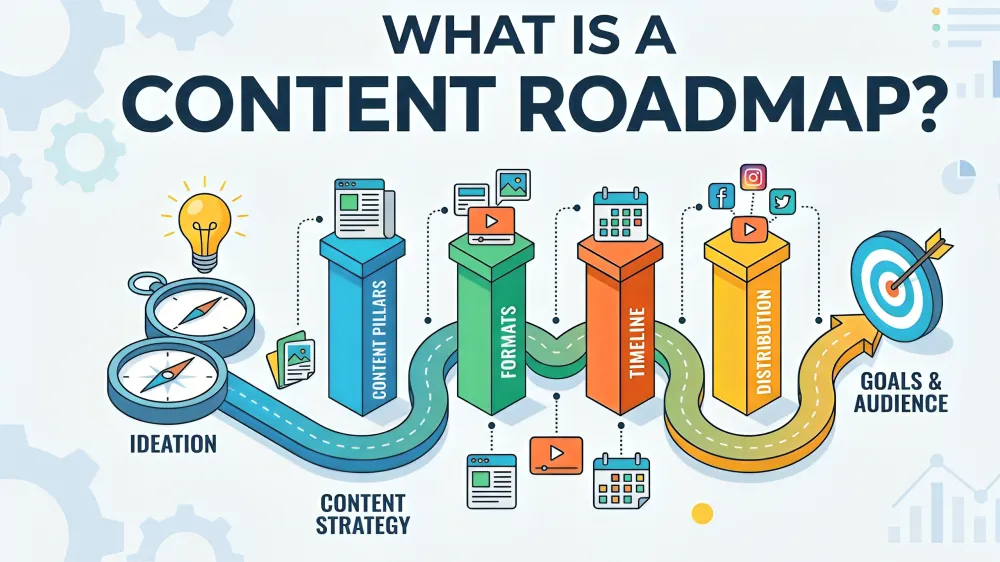
Content creation often looks easy from the outside, yet most teams struggle with consistency and direction. They make blogs, videos, and posts, but they do not relate those activities and the actual business objectives. Due to this break, performance remains unstable and the growth is less efficient with time. It is there that it becomes critical of marketing people and business owners to know what is a content roadmap. It gives structure, clarity, and focus to all content activities. This in-depth article will explained to you what a content roadmap is, how it functions, why it is important and how it can be integrated into good content marketing strategies. Meanwhile, you will notice how it fits into a more realistic content marketing guide in order to prepare your planning more efficient and simple to accomplish.
What is a content marketing roadmap?
A content marketing roadmap is a guide, but this time one that lets you plan your content ideas, schedules, tasks, and objectives in a cohesive place. It relates the day-to-day content undertakings and the long-term marketing goals in a manner that no content goes to waste. Additionally, it makes sure that your team is not working ad hoc. Rather, every blog post, email campaign, or other social updates has a specific path. As an illustration, when a company is about to launch a product, they will use a roadmap to plan in advance the blogs to write before the product, the announcement emails, and the follow-up content. Consequently, each action contributes towards achieving the same and enhances the overall influence.
How it works in real situations?
A roadmap is similar to a roadmap; it is a visual plan that is used to guide your content. It indicates how, who, and when it must occur. Hence, you are not guessing what to do next but rather have a logical flow of actions.
- It connects ideas with execution
- It assigns tasks to specific team members
- It sets realistic deadlines for each activity
Because of this structure, teams avoid confusion and maintain steady progress across campaigns.
What elements should a content marketing roadmap include?
Every good roadmap has several elements that ensure that everything is structured and aligned to business objectives. Every aspect brings about clarity, direction, purpose and as such, teams are not lost in confusion nor do they take time to move.
1. Content mission that defines direction
A content mission goes on to clarify the purpose of the content and the audience. It is considered target-oriented, the needs of the target group, and the value that the brand intends to provide. Due to such clarity, all the pieces of content seem to be integrated and intentional instead of arbitrary.
2. Marketing and business goals that drive results
Clear goals subdivide the mission into a measurable outcome, such as increasing traffic, generating leads, or creating brand awareness. These objectives assist the groups in maintaining focus and keeping an eye on the progress. This leads to content being more strategic and less experimental.
3. A timeline that organizes execution
A timeline is an organization of tasks into deadlines and duties. It keeps content publishing on schedule and campaigns on time. In addition, it enables the teams to re-allocate schedules as priorities change.
4. Content types for structure creation
There should be a correct classification of different forms of blogs, videos, emails, and social posts. This organization assists teams to fail to repeat content and balancing types. As a result, the roadmap is multi-dimensional and captivating.
How do content marketing strategies connect with roadmap planning?
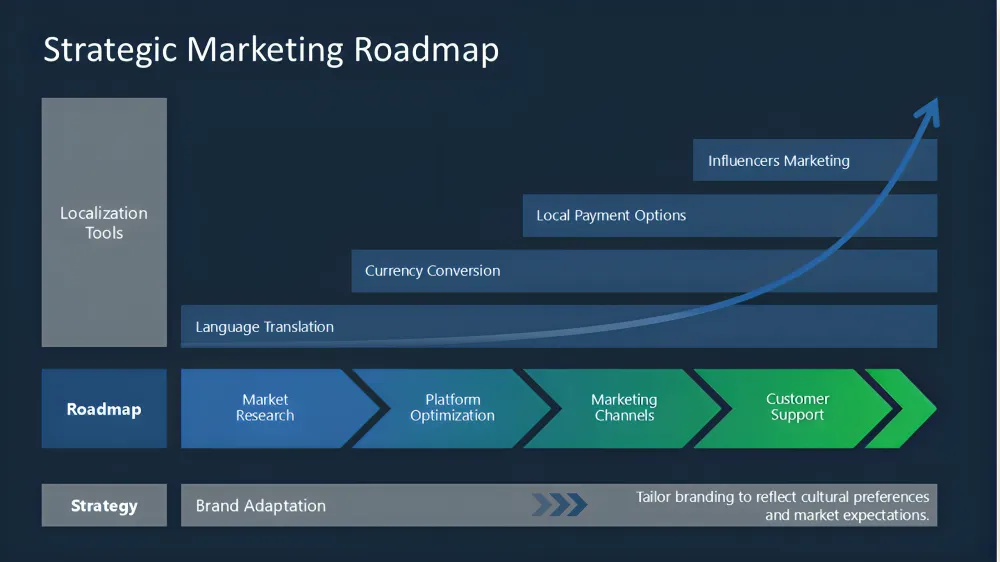
Planning of the content will only have a sense as long as it is working with excellent strategies. Good content marketing techniques help to ensure that no content is present haphazardly, but rather purposeful.
Furthermore, these plans assist in determining the appropriate audience and platforms, as well as formats. To illustrate, a brand that is marketed to professionals might consider the informative blogs and Linked In posts. This causes the roadmap to get these decisions and be consistent.
Steps to connect strategy with execution
- Define your audience clearly
- Set realistic and measurable goals
- Choose suitable content formats
- Align publishing schedules with audience behavior
Because of this connection, your content becomes more targeted and impactful over time.
How does a content marketing guide support roadmap execution?
An organization has a structured approach that assists in ensuring quality content across all efforts and also guides the teams through a systematic process. It serves as a guide that makes it easy to execute and lessens misunderstanding.
Creating clear writing standards
A guide specifies tone, style, and formatting guidelines such that all the content appears to be the same. It guarantees that all the pieces are presented with the same brand voice. Due to this, readers receive a cross-platform dumping of the message.
Defining workflows and responsibilities
A clear workflow defines who does the planning, writing, editing and publishing. The construction minimizes time wastage and duplication of activity. Consequently, teams are able to work in an effective way without miscommunication.
Integrating SEO and optimization practices
Keywords and formatting guidelines, as well as optimization tricks, are provided in the guide. Such practices increase visibility and contribute to the better ranking of the content in search results. Thus, it becomes easier to find the content.
Maintaining quality control
Review and editing processes help in maintaining quality content before it is published. The aim of this step is to minimize mistakes and enhance readability. The end result is thus refined and professional.
Practical steps to build an effective content roadmap
Creating a roadmap becomes simple when you follow a clear sequence of steps. Every step provides the structure and assists the conversion of ideas into a working plan.
Defining the target audience
Knowing the audience assists in determining their needs, preferences and problems. This has been enabled by clarity so that content can be relevant and interesting. Consequently, the roadmap is in line with actual user intent.
Setting clear objectives
The content strategy is aimed at meeting such goals as traffic growth, lead generation, or interest. These goals give guidance and assist in goal measurement. Thus, each move counts.
Planning content ideas
Topics and format listing will also ensure the roadmap contains sufficient content to be used in campaigns. It is also effective in maintaining consistency. As a result, the production of content is more streamlined.
Assigning roles and responsibilities
There must be owners of each job to execute. This responsibility minimizes confusion and enhances efficiency. This, in turn leads to timely project progress.
Creating a timeline
Deadlines can be used to maintain consistency and keep campaigns within track. It also gives the teams the opportunity to prioritize tasks. Thus, the timing of the publication of content is appropriate.
Tracking and improving performance
Occasionally, keeping track of results will reveal what is effective and what should be improved upon. Teams have an opportunity to change the approach based on information and feedback. This way, performance is constantly improved.
Common challenges and how to solve them
In spite of a roadmap, teams can encounter difficulties. But knowing these problems would assist in quick and effective solutions. Lack of flexibility is one of the problems. Sometimes there is a change in priorities and plans require alterations. Consequently, one should make the roadmap flexible. The other challenge is the communication problem, where ineffective communication can hinder progress and efficiency.
Solutions overview
| Challenge | Solution |
| Rigid planning | Keep roadmap flexible |
| Poor communication | Use regular updates |
| Missed deadlines | Set realistic timelines |
| Weak tracking | Use clear performance metrics |
As a result, teams can maintain productivity even during complex projects.
Long-term impact of using a content roadmap
Teams that have a roadmap that they are regularly using will observe improvements with time. There is an increased focus on content, campaign organization is more structured, and measuring the result is more accessible. In addition, one can magnify the business without compromising quality. To illustrate, a developing company will be able to pursue numerous campaigns simultaneously since the roadmap will have everything arranged. Thus, growth will be predictable and sustainable.
Conclusion
Understanding what is a content roadmap helps you bring structure and clarity to your content efforts. It connects strategy with execution while ensuring consistent and measurable results. When you apply this approach properly, your content becomes more focused, organized, and aligned with your long-term goals.
FAQs
Q1. What a is content roadmap?
Ans. A content roadmap is a high-level plan that defines what content you will produce, when and how it fits with your business objectives. It helps marketers brainstorm, prioritize, and stay consistent with blog posts, social media and other content efforts.
Q2. Why do you need a content roadmap?
Ans. It keeps your content strategy in check, makes things consistent and stops you from publishing content on the fly. It also facilitates teamwork and enhances long-term SEO.
Q3. What goes in a content roadmap?
Ans. A content roadmap will include: Target audience Content topics and keywords Publishing schedule Content types (blog, video, social media) Distribution channels Goals and KPIs
Q4. What’s the difference between a content roadmap and content calendar?
Ans. A content roadmap is more strategic and long-term, outlining a plan for content, whereas a content calendar is more tactical and short-term, including specific dates and deadlines.
Q5. How do you build a content roadmap?
Ans. To create a content roadmap: Define your goals Research keywords Understand your audience Plan content topics Set a publishing timeline Track performance and update regularly