
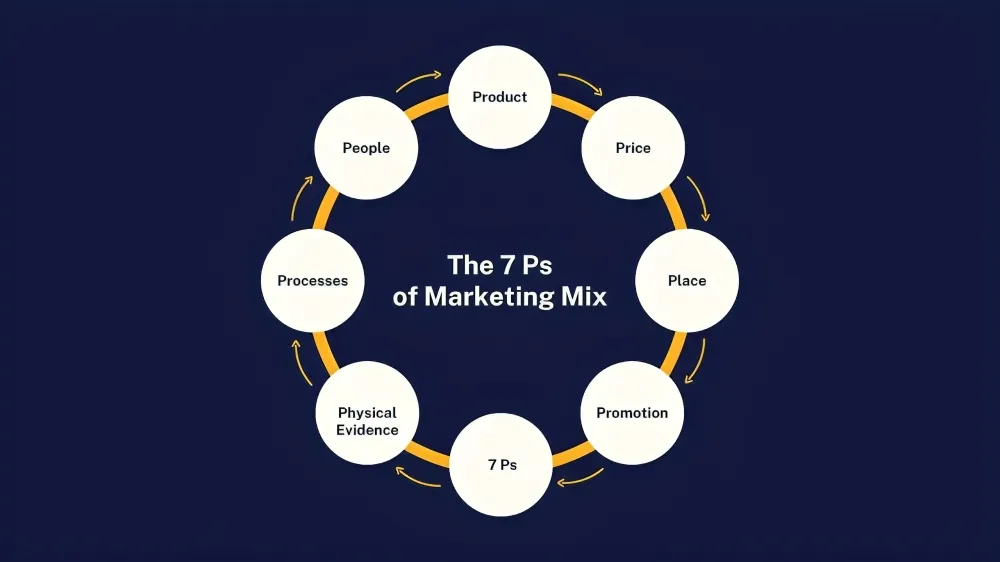
Every successful business follows a system, even if it does not openly admit it. There are some brands that improve progressively, whereas some brands cannot maintain the image, and it might be reduced to the extent or degree to which they comprehend and realize the methodical marketing concepts practically. It is in this case that the 7 Ps of marketing would be very pertinent since they would have created an end-to-end perspective in the way in which a business is supposed to carry out communication as well as deliver value in the competitive marketplace.
Simultaneously, even nowadays, many individuals pose easy yet significant questions such as what are the 7 ps of marketing as they do not want to get confused. This article discusses this question in detail and further elaborates how each of these elements links to actual businesses decisions. In addition, the discussion does not merely dwell on theoretical information but on practical knowledge, to enable readers apply the information with the confidence.
What Is Marketing Mix?
The marketing mix is the basis of any strategy and it provides a simple answer to a question: what is marketing mix and how companies apply it to generate value. It is a highly organized methodology in which two or more elements are in collaboration rather than in isolation. Thus, companies adhering to this system can make better plans and not resort to making random decisions.
Additionally, the concept of marketing 7 Ps are an elaboration of this concept, as it is not only product and price anymore. It also takes into consideration the experience, delivery and human interaction which is necessary in the current market. This means that the companies are able to develop a steady and trustworthy brand image in various mediums.
What Are the 7 Ps of Marketing and How They Shape Strategy?
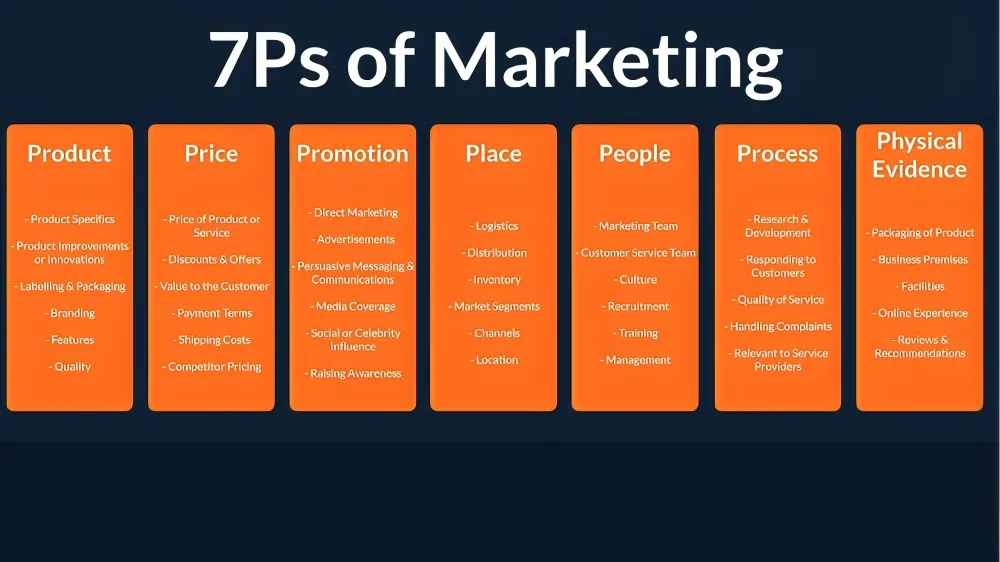
The 7 Ps of marketing describe a clear and practical framework that businesses use to plan and manage their marketing strategy effectively. It originated with four elements product, price, place and promotion and came to be extended to four by covering people, packaging and process which share the current business requirements. All these aspects combine to form a balanced methodology that enables companies to create value, express themselves effectively and enhance customer experience throughout all the purchasing history.
Simply put, It helps businesses to make better decisions, in particular, when they are concerned with reaching the right audience and shine in competitive markets. In addition, this framework promotes the day to day marketing operations by making sure that all actions are mindful of the general objectives. This leaves small business owners and marketing management to rely on it to create great strategies, work better and to expand the brand in confidence.
The 7 Elements of the Marketing Mix
The seven components of the marketing mix entails a systematic approach to the business strategies to plan and execute with clarity and uniformity. All the elements assist one of the steps the customer passes, and in case all the elements support each other correctly, the whole performance increases automatically. In addition, the approach assists businesses to reduce trade-offs between internal business and external communication but results in improved customer experiences and brand positioning.
Meanwhile, the restricted strategies could not be employed in contemporary business. Instead, they must integrate core ideas like marketing fundamentals, content marketing, and marketing segmentation within these elements to create a complete and effective system. As a result, companies can deliver value consistently while adapting to changing market trends with confidence.
1. Product (or Service)
The product represents the core offering, and it defines what the business delivers to its customers. A product should answer a tangible problem, be able to offer concrete benefits and live up to those expectations. This means that the companies must work on quality, usability and differentiation in order to be distinguished in the business arena.
Also a developed product generates trust with time, as they clients are able to expect a performance that is consistent. Promotion and selling becomes easier when a product is in line with the needs of customers. This is due to the fact that strong brands do not just engage in marketing activities but intensely invest on product development.
| Product Aspect | Customer Benefit |
| Quality | Builds reliability |
| Features | Enhances usability |
| Design | Attracts attention |
Furthermore, a strong product reduces the need for aggressive promotion, because satisfied customers naturally recommend it to others.
2. Price
Value of the product is indicated by price and it affects customer perceptions and buying behaviour directly. The pricing should be done cautiously by businesses as high and low pricing may produce varying impressions. Thus, pricing must be related to the general brand strategy.
Also, there are various pricing models applied by the company, depending on their objectives. As an example, competitive pricing would appeal to more audiences compared to premium pricing which generates a sense of exclusivity. But every strategy should correspond to the quality of a product, in order to be credible.
| Pricing Strategy | Purpose | Outcome |
| Premium | High value perception | Strong brand image |
| Competitive | Market balance | Wider reach |
| Penetration | Quick entry | Fast growth |
Consequently, pricing decisions should support long-term growth instead of short-term gains.
3. Promotion
Promotion is based on communication and determines how businesses show the market how their products are in a manner that is understandable and interesting. It involves advertising, use of social media, emailing campaigns and content marketing plans which gain attention and create awareness in the most effective way.
Moreover, there is no single channel of promoting effectively, since customers deal with brands through various platforms. Rather, it integrates various channels to form common and unified message. An example is that a customer might see an advert, next visit a web site and lastly make a purchase on reading reviews and testimonials.
4. Place
Place determines where customers can find and purchase a product, and it plays a key role in accessibility. Businesses need to select the appropriate channels be it online or helium channels to suit customer preferences.
In addition, convenience is also a significant consideration in buying. Customers are demanding convenience in access, speedy delivery and fluid transactions. Businesses need to work on making the buying process less pervasive, therefore.
As an example, online shopping will have customers shopping 24 hours and in-store shopping involves a hands-on experience. As a result, a mixture of the two techniques is currently being employed by a lot of brands in order to have the maximum reach.
5. People
People represent the human side of the business, and they influence customer experience directly. Brand perception is shaped with the involvement of employees, customer service teams, and even the management. Also, a highly trained employees are able to accomplish customer satisfaction to a bigger degree, since they will treat customers professionally and with care.
Customers are likely to come back and refer their friends or relatives to buy the brand, when they feel appreciated. In addition, good internal culture is displayed in the outside communication. The companies must hence engage in training, motivational and communication abilities to reinforce this aspect.
6. Packaging
Packaging is an important factor in customer attraction and valuing of products. It forms the initial impression and it can bring the purchasing decisions in few seconds. Moreover, efficient packaging is a mix of design, information and usability. An attractive package is an eye-catcher and coherent information is a trust-maker. Thus, aesthetics and functionality are crucial aspects that must be paid attention to by businesses.
Furthermore, branding is reinforced through packaging since things are consistently packaged using the same colors, fonts, and texts. Due to this, the customers are able to identify the product in a congested market.
7. Process
Process refers to the systems and procedures that deliver the product or service to customers. It guarantees uniformity, effectiveness and dependability in operations. Additionally, efficient process will enhance customer experience, owing to the fact that it minimizes delays and errors. To illustrate, fast confirmation of orders and the delivery time makes a good impression.
Moreover, companies ought to assess their processes on a regular basis in order to make improvements. When operations are operating in a successful manner, the employees are able to work more on customer satisfaction as opposed to problem-solving.
Conclusion
The 7 Ps of marketing offer an all-inclusive guide that can assist companies in strategizing and implementing their plans. All these factors will add up to create the presence of strong and consistent brand. When businesses align all the seven elements, they bring customers about enhanced experiences and long growth.