
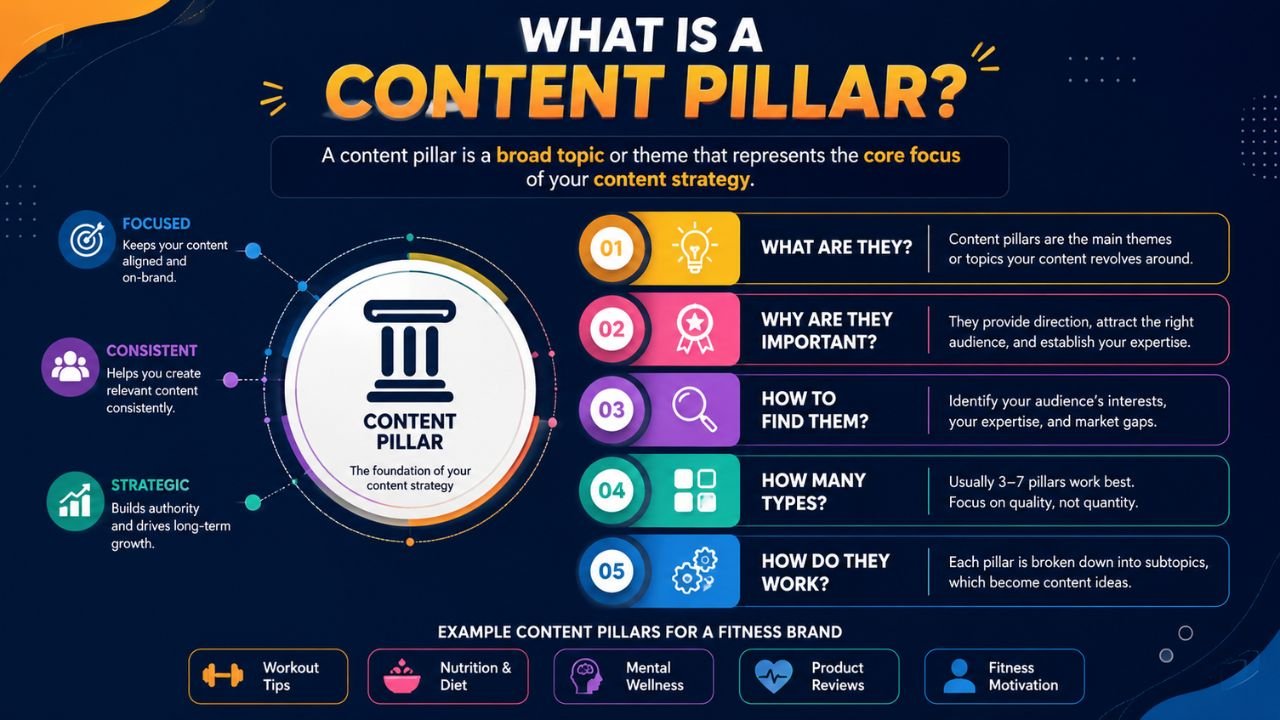
Most content strategies look active but deliver weak results. Regular publication of brands but minimal changes in their organic traffic. It is not really about hard work. It is structured. Devoid of a defining structure, the content is aimlessly moving and does not accrue the type of authority that search engines favor. Pillars of content address this by creating a structure around everything you publish of focused, strategic themes that make value over time.
A content pillar is a general central subject around which your brand has ownership and creates content. But what is a content pillar? It is its main subject that unites your blogs, videos, social posts, and guides into a single content ecosystem. You do not put anything on the Internet; you post with a purpose. Each work supports a theme and all of them work as an indicator of true skill to readers as well as Google.
What Is a Content Pillar?
A content pillar is a general, central theme that your brand owns and creates all the content around it. It is a theme that is something that correlates directly to your products, services or values. The content of each post on your blog, each video, each social update, and each email should then be linked to one of your selected pillars. Imagine that it is the base of a house. When there is no good foundation, whatever is constructed on the foundation will keep on moving or falling. The content it has to cover is organized into content pillars to create that stable foundation so your content can grow in a focused, compounding direction and not be put out thin on any of these empty subjects.
For example, a fitness brand might choose “weight training” as one of its core content pillars. From there, it builds content on beginner routines, nutrition plans, recovery strategies, and equipment guides. Each piece connects back to the main pillar, and together they signal genuine expertise to both readers and search engines.
How Does a Pillar Content Strategy Actually Work?
What is a content pillar strategy? It systemizes your content as a hub and spokes. The pillar page is more of a hub that discusses a general topic on a high level. The topic clusters/ spokes are particular items of content that further explain individual sub-sensitive topics in that theme. All of the spokes are connected to the pillar page, and each of the pillars is connected to all of the spokes.
This two-way n-connection accomplishes two significant tasks. First, it assists Google in determining how well-knowledgeable you are on a subject. Second, it takes users through your content ecosystem in a natural way, boosting the time they spend on the site and lowering bounces.
Here is a simple breakdown of how the structure looks in practice:
| Content Level | Role | Example |
| Pillar Page | Broad hub covering the core topic | “The Complete Guide to Outdoor Furniture” |
| Cluster Content | Deep dives into specific subtopics | “How to Choose the Right Patio Set” |
| Cluster Content | Targets long-tail search queries | “Best Materials for Weather-Resistant Furniture” |
| Cluster Content | Answers specific audience questions | “How to Store Outdoor Furniture in Winter” |
| Internal Links | Connect all pieces back to the pillar | Embedded links within every cluster article |
Each cluster article returns power to the pillar page. That authority is spread out in the pillar page in all clusters. It is this network effect that is the difference between a content pillar strategy and random blogging.
Why a Pillar Content Strategy Improves Search Rankings
Google is currently testing its websites by a pillar content strategy. Google does not rank pages in individual formats. Rather, it evaluates the completeness in topicality of the whole site and then makes decisions about the credibility of a site regarding a topic. Sites that are well-rounded and comprehensive in their coverage of a topic with well-developed internal links between related information will always out do sites that publish articles at random and without any connections.
How Google E-E-A-T Rewards Pillar Content
The E-E-A-T model of Google is Experience, Expertise, Authoritativeness and Trustworthiness. An effective content pillar plan meets all four indicators in a natural manner. Having presented your material in various directions with facts that are correct and well-analyzed, then you show true professionalism. Authoritativeness is built when other sites refer to your pillar pages. Your content always provides answers to what the reader requires; this goes a long way in gaining continued trust both on the side of the user and the engine.
Internal Linking as a Ranking Signal
Internal association is the glue of your pillar approach. All cluster pieces must have a connection to the pillar page. The pillar page ought to be connected to all the clusters. Pieces that are part of clusters must also cross-link at points of necessity. This connection design spreads page power throughout your content ecosystem and assists search crawlers in charting the hierarchy of subject matter in your site in a way that is easily and efficiently charted.
How to Build a Pillar Content Strategy from Scratch
Developing a content pillar strategy involves a definite process. It is not a matter of getting more published. Pillar content is regarded publishing smarter with each item playing a specific purpose in your content architecture. It is a step-by-step process that will work in any brand, regardless of size.
Step 1: Research Your Audience First
Before choosing your pillars, understand who you are creating content for. Check your buyer personas and determine the main issues your audience has. Create the right image with Google Analytics 4, social media insights, and customer feedback. Remodel your personas before committing any decisions on pillars; otherwise, they will be out of date. Your pillars should be in line with the actual audience’s needs, not necessarily what your brand desires to discuss.
Step 2: Choose Three to Four Focused Pillars
Find three to four general subjects that relate to your business objectives and the interests of your audience. It is better to stick to four pillars at best since any more dilutes your resources. It does not allow you to develop true depth around one of the themes. Determine the level of search demand around each pillar topic to confirm that there is sufficient search demand to warrant content investment.
Step 3: Audit and Map Existing Content
Before creating anything new, audit what you already have. Overmap all your existing pages to any of your selected pillars. It is likely that you will find out that good material is already available, but without good linking and organization. Sorting out the existing material into your pillar structure can frequently provide fast SEO gains prior to you writing a single article.
Step 4: Create Comprehensive Pillar Pages
The content on each pillar page ought to discuss its theme in a general manner. It will need to establish the most important concepts, respond to the most frequently asked questions, and provide references to all of the cluster material. Prepare these pages to be read by readers and search engines. You should keep them informed periodically as your cluster material expands and your industry is enriched with new information and fashions.
Step 5: Develop Cluster Content Consistently
Produce standalone pieces of content under each subtopic of a pillar. Every article ought to focus on a particular keyword, it ought to have a definite search purpose, and must contain a link back to the pillar page. The more thorough a cluster is the better a signal of topical authority you develop over time.
Pillar Content Strategy: Hub vs Spoke Structure at a Glance
| Content Level | Role in Strategy | Example |
| Pillar Page | Broad hub covering the core topic | “The Complete Guide to Outdoor Furniture” |
| Cluster Content | Deep dives into specific subtopics | “How to Choose the Right Patio Set” |
| Cluster Content | Targets long-tail search queries | “Best Materials for Weather-Resistant Furniture” |
| Cluster Content | Answers specific audience questions | “How to Store Outdoor Furniture in Winter” |
| Internal Links | Connects all pieces back to the pillar | Embedded links within every cluster article |
Examples of Pillar Content from Real Brands
When you consider real brands, the pillar framework becomes much easier to comprehend and utilize. Such demonstrations of the pillar content acquire the idea of how the thematic focus could be used consistently to create brand authority and organic reach simultaneously. All the brands under each adopted transparent pillars and remained faithful to these in all the mediums they utilized.
Patagonia: Three Pillars, One Clear Identity
At Patagonia, all its content is structured around three pillars: outdoor lifestyle and sports, environmental activism, and sustainability. All blog posts, campaigns, and social updates will tie back to one of these themes. The brand is not merely a seller of clothing. It informs its viewers about environmental concerns, records on outdoor exploits, and promotes environmentally sound manufacturing. This uniformity provides Patagonia with authority backlinks from media and environmental agencies, which boosts its search results over time by a factor of four.
Dove: Turning Brand Values into Content Themes
Three strong pillars that Dove relied on to shape its content strategy include beauty and skincare, empowerment and self-esteem, and inclusion and diversity. Their Real Beauty campaign in 2004 turned out to be a multi-decade content pillar in practice. All of the videos, social posts, and campaigns that Dove produces support either of these three themes. Due to this, Dove established a global reputation as one of the best-known beauty brands, not based on the promo-noise or aggressive advertising, but the consistency of the content used.
Innocent Drinks: Community and Humor as Content Pillars
Innocent Drinks bases its content on the three layers, that are, healthy drinks and food, community, and sustainability. Their community pillar is directly triggered, in a memorable and shareable manner, through their Big Knit campaign that generates funds to the Age UK via community involvement. This sustainability pillar became real when they were certified B Corp in 2018 with their sustainability being supported by the third-party. A combination of these pillars establishes familiar brand voice that cuts through across all mediums, which they employ.
Common Mistakes That Weaken Your Content Pillar Strategy
Even the best planned pillar solutions are hampered when implementation becomes compromised. Being aware of the most frequent errors can allow you to thwart them before they cause you rankings and time wastage. Therefore, before your construction, make sure you are not trapping into any of these traps.
- Choosing too many pillars spreads resources thin and prevents deep topical coverage on any single theme.
- Building a pillar page without cluster content around it leaves the strategy structurally incomplete.
- Skipping internal linking breaks the authority flow between pillar and cluster pages
- Treating pillar pages as one-time projects causes them to go stale and gradually lose ranking power.
- Ignoring search intent when selecting cluster topics leads to content that does not attract organic traffic.
- Writing cluster content without linking it back to the pillar defeats the entire hub-and-spoke purpose.
Using AI Tools to Support Your Content Pillar Strategy
The use of AI tools such as ChatGPT, Claude, Perplexity, and Gemini truly accelerates the pillar ideation and cluster mapping process. They assist you in brainstorming subtopics and finding gaps in the content and writing outlines that cannot be accomplished by hand research. With that said, the final pillar content must always be human-experienced and with a regular brand voice to work.
Here is a sample prompt you can use directly with any AI tool to get started:
“My main topic is outdoor furniture. Suggest between 3 and 8 content pillars. Present them in a table with Pillars as the first column and Topics as the second column. Format the topics as a dashed list.”
Turn to AI to be used as a research and writing assistant, and refine the work into something that feels like true knowledge and a clearly defined brand vision. AI can speed up the process but is not a substitute for the judgment and insight that make the pillar content truly authoritative in the long term.
Conclusion
A strong content strategy is not built overnight, but its results compound steadily with every piece of content you publish. After getting what is a content pillar and putting it into practice with an attention span, you will not be publishing at will, but will be establishing something that will gain strength over time. Select three to four pillars and identify them according to the real needs of your audience. Construct your cluster systematically around each of them. Keep your pillar pages current and internal links tight. Consumer-friendly brands that remain consistent with this pattern create content ecosystems that are truly difficult to copy by a competitor, and that is the type of long-term competitive advantage that can be invested in.
FAQs
A content pillar is a comprehensive, in-depth piece of content that covers a broad core topic in full detail. It acts as the central hub of your content strategy, with smaller, related subtopic pieces (called cluster content) linking back to it. Content pillars help organize your website’s structure and signal topical authority to Google.
There are three main types of content pillars:
The 10x Pillar Page — a long-form guide that goes deeper than any competitor on a topic.
The Resource Page — a curated list of tools, tips, or links around a core subject.
The “What Is” Page — a definitional page that explains a concept clearly, ideal for top-of-funnel searchers.
Content pillars are important for SEO because they help search engines understand your website’s topical authority. When a pillar page links to multiple cluster blog posts — and those posts link back — it creates a strong internal linking structure. This signals to Google that your site is a trusted, expert source on that topic, which can improve rankings across all related pages.
A: A blog post typically covers one specific subtopic in isolation, while a content pillar covers a broad topic comprehensively and connects to multiple related blog posts. Think of a content pillar as the “parent page” and blog posts as the “child pages.” A pillar page is usually longer (2,000–5,000+ words), more evergreen, and strategically placed at the center of a topic cluster.
To create a content pillar strategy, follow these steps:
1. Choose a broad core topic relevant to your business or niche.
2. Identify subtopics (cluster keywords) that fall under that main topic.
3. Create a long-form pillar page that covers the core topic in depth.
4. Write cluster content (blogs, guides, videos) targeting each subtopic.
5. Interlink everything — cluster pages link to the pillar, and the pillar links to clusters.
6. Track and update your pillar page regularly to keep it fresh and ranking.