
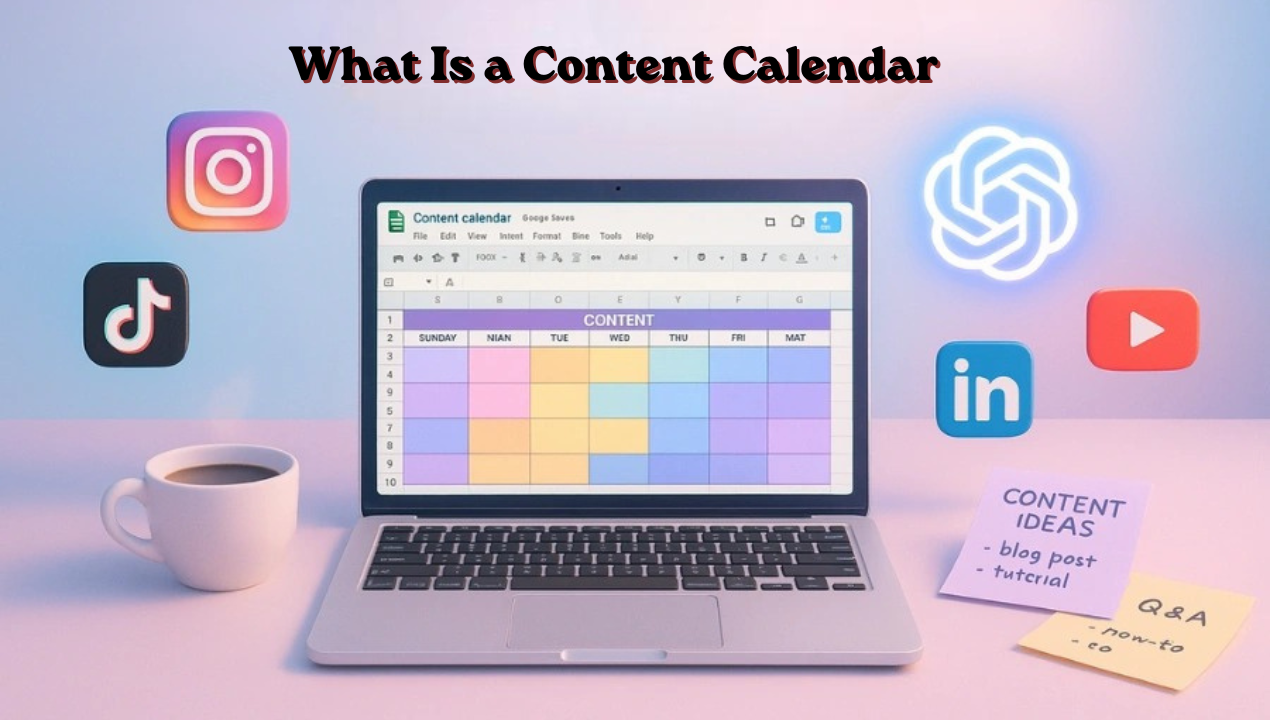
Content creation looks easy from the outside, but when it comes to working on the task on a daily basis, the challenge truly begins. You can have ideas, but without organization, you tend to be left with ideas in your head. That is why lots of teams are now concentrated on knowing what is a content calendar, as it can assist them to convert disorganized ideas into a well-structured and coherent plan.
Additionally, the contemporary online environment requires frequent new content, effective communication, and consistency. But without planning, content will be undisciplined and useless. Consequently, by having a content calendar coupled with a strategy roadmap, you design a system that will assist both short-term assignments as well as long-term development.
What is a Content Calendar for Organized Content Planning?
A content calendar is a planning system that enables you to plan your content ideas, give timeframes and monitor the progress effectively. You are not following a structured approach and just publishing what is caught in your mind and released randomly, but you are systematically doing this and all content is released at the right time.
When you clearly understand what is a content calendar, you begin to see how it simplifies daily content operations. For example, a marketing department will be able to schedule blog posts, email campaigns, and social media errands for a whole month. This makes them eliminate last-minute panics and ensure uniformity in all the media.
Key Components That Define a Content Calendar
| Content Type | Topic | Platform | Date | Status |
| Blog | SEO basics | Website | 10 May | Draft |
| Social Post | Product tips | 12 May | Planned | |
| Weekly update | Newsletter | 15 May | Pending |
In addition, each entry may include assigned team members, deadlines, and performance goals. Therefore, the calendar acts as a central hub for all content-related activities.
What Is a Content Roadmap and How Does It Guide Long-Term Direction?
While a calendar helps manage daily tasks, you also need a bigger picture to guide your efforts. This is where the question many professionals ask is What is a content roadmap, and how does it integrate within the process. A content roadmap is an overarching plan beyond months or even years, outlining what you will do with your content.
As an example, when you have a purpose of growing organic traffic, your roadmap could be centered on SEO-based content within the following quarter. In the meantime, your calendar splits that plan into weekly assignments. Consequently, the two tools collaborate in order to achieve congruence between strategy and execution.
| Feature | Content Calendar | Content Roadmap |
| Focus | Daily planning | Strategic vision |
| Timeline | Weekly or monthly | Quarterly or yearly |
| Purpose | Task execution | Direction and goals |
Therefore, understanding the content roadmap ensures that your content always supports your business objectives.
Why Using a Content Calendar Improves Content Strategy and Workflow
A content calendar is organized, transparent, and predictable, the key to effective marketing. First, it puts all your material under one roof and thus you can easily follow through and prevent confusion. Moreover, it also enhances the communication within a team since everybody is able to access the same information.
Also, you can maintain consistency with a plan ahead. You are not required to post at random, but a schedule that keeps the audience interested. Meanwhile, you are able to organize future events and possible campaigns.
Key Benefits of Using a Content Calendar
- Clear organization of content tasks
- Improved collaboration within teams
- Consistent publishing schedule
- Better visibility of future campaigns
For example, a growing startup increased its engagement by planning content weekly instead of posting randomly. As a result, their audience became more active and responsive.
Organizing Marketing Activities with Better Structure
As your content volume grows, managing everything manually becomes difficult. Nonetheless, the content calendar makes this task easier because it puts all activities in a single place. Thus, it is very easy to follow what is going on or what is to be done.
Furthermore, systematic planning enables you to find holes in your plan. An example of this is when you realize that you are not learning enough, then you can change your timetable. Thus, your content will be more balanced and effective.
Enhancing Collaboration Across Teams with Shared Access
When everyone is on a common system, teamwork within the operation of a team is enhanced. A content calendar keeps every participant of the team aware of the duties, deadlines, and tasks. Consequently, there will be easier and efficient communication.
Moreover, remote working teams can easily collaborate with the help of cloud-based calendars. All members are able to receive real-time updates and this will help minimize the confusion and delays. Consequently, teamwork becomes more productive.
Maintaining Consistency Across Content Channels
Stability is an important factor in establishing confidence with your audience. A content calendar allows you to keep things regular and establish congruence in posting and regular communication. Thus, your brand will be more familiar and trustworthy.
Besides, the regular content enhances your identity and performance. Users have more confidence in engaging with your content when they know what to expect. This leads to an increased reach and visibility.
Supporting Long-Term Campaign Planning and Execution
Long-term planning enables companies to plan in advance the future opportunities and campaigns. A content calendar helps you to work out content several months ahead and be flexible enough to make adjustments. As a result, you will be able to manage any planned and unplanned situations. For example, you can create content to respond to seasonal campaigns or product launches in advance. Thus, you eliminate last-minute stress and save quality.
Managing Social Media Content with Better Control
Without planning, it is easy to be overwhelmed managing various social media platforms. But a content calendar gathers all posts that you have, making it easier to keep current and control it. You will also be able to schedule the posts and keep up with specialized presence on the Internet. Consequently, your social media plan becomes more planful and productive.
Tracking Content Performance for Continuous Improvement
Performance tracking helps you understand what works and what does not. A content calendar allows you to monitor key metrics such as views, engagement, and conversions.
| Content Type | Views | Engagement | Result |
| Blog | 2200 | High | Strong |
| Social Post | 900 | Medium | Moderate |
| 600 | Low | Improve |
Due to this data, you can clarify your approach and concentrate on the successful content. Thus, it becomes possible to have continuous improvement.
Preventing Missed Deadlines and Content Gaps
Failure to meet deadlines may derail your whole content strategy. But a content calendar gives a good understanding of activities and time plans, making the chances of mistakes lower. Besides, systematic planning will make sure that no aspects are forgotten. This way, your workflow is not disrupted and is considered dependable.
Step-by-Step Process to Create and Maintain a Content Calendar
A clear process helps you manage content without confusion and keeps every task aligned with your goals.
Step 1: Identifying Content Types for Better Organization
Begin with a list of all content types in the form of blogs, emails, and social posts. This action puts a perspective on what you indeed create and publish. In addition, it assists you in balancing the various formats and in avoiding using the same format.
Step 2: Breaking Work into Manageable Tasks
Divide each content piece into smaller tasks like research, writing, and editing. This method eliminates wastage and nothing is left behind. This leads to a workflow that is easier to follow due to its smoothness.
Step 3: Assigning Deadlines and Responsibilities
Establish specific deadlines on every activity and delegate the activity to particular members of the team. This will enhance accountability and prevent misunderstandings in the team. This then means everybody is familiar with what and when to do it.
Step 4: Setting Milestones for Progress Tracking
Add Gateways at every step of content production to keep track of the development. Such milestones are used to detect failures in time and correct them promptly. As such, your schedule will remain on schedule.
Step 5: Defining Content Goals for Each Piece
Each piece of content must serve a purpose of either traffic generation or greater engagement. Success can be measured more easily when there are clear goals. This makes your strategy better with time.
Step 6: Reviewing and Updating Regularly
Keep your calendar updated on a weekly or monthly basis to record the changes and improvements. Frequent revision will make your plan pertinent and efficient. As a result, your content remains on track with your goals.
Integrating Content Tools into Your Marketing Strategy
No longer a problem when your business is developing. In this way, the efficiency and accuracy will be increased by using advanced tools. These tools are the scheduling, collaboration and analytics. Moreover, this approach enables you to handle complex workflows easily by implementing the same. Thus, your staff can focus more on innovation and creativity.
Advanced Tips to Improve Content Planning and Execution
After having your system in progress, it is much better to refine your strategy in order to get to better results and to become more efficient.
1. Audience Behavior to Improve Content
Read, watch, and get involved with what your audience is frequently reading, watching, and listening to. Such knowledge will help you to come up with more relevant and effective content. In this way, your content is more connected with your audience.
2. Experiments with the Formats of different content
Through trial Blogs, video and social postings to find out what works best. Different formats possess diverse audiences and improve reach. Therefore, you get a more lenient strategy.
3. Content, Business Objectives
Make sure that all pieces of content are beneficial to your overall objectives in business. This relationship puts a close relation in growth and marketing. This implies that your work produces better results.
4. Strategy Refinement with Performance Data
Periodically analyze view, click and interaction measurements. This data shows what is effective, and what needs to be enhanced. In this way, you will have the capability to make improved decisions.
5. Keeping A Balance between Quality and Quantity
Focus on relevant information as opposed to wall-posting. Trust and credibility will be generated through quality content. This means that you have not bored your listeners.
Conclusion
Understanding what is a content calendar can guide you to add some structure, clarity, and consistency to your content strategy. It will allow you to plan, prepare and comply with a publication plan in all channels. At the same time, a combination of both with a content roadmap will determine whether your day-to-day practice is geared towards the long-term goals.
Moreover, this approach contributes to increased cooperation and reduces the number of errors, as well as promotes efficiency. With such systems systematically embraced frequently, your content is going to be structured and productive. Indirectly, the content calendar and roadmap provide a solid foundation for sustainable growth and success.