
Have you ever wondered why some websites appear on the first page of Google while others stay buried deep in the search results? In many cases, the answer starts with keywords. Each query that occurs on Google is a result of typing a word, phrase, or question into the Google search engine. When businesses, bloggers, and marketers engage in deciphering those types of searches, they tend to be more visible, experience improved traffic, and produce content that will resolve actual user desires. This is precisely why it is important to get acquainted with what is google keywords. Keywords are not arbitrary phrases that have been introduced on a webpage. They assist Google in recognizing the subject of a page and relate it to individuals looking into related data. Keywords play a significant role in the process, whether one wants to purchase something, to make a comparison of services, or to find a quick answer.
Novices emphasize search volume and do not pay attention to user intent. Succeeding sites, however, go further. They investigate search methods of individuals, the issue or problem they intend to find an answer to and keywords they employ at various stages of decision making. This article will teach you the mechanics of Google Keywords, their importance and how businesses can use them to enhance both paid and SEO performance.
What Is Google Keywords and How Does It Impact SEO and Google Ads?
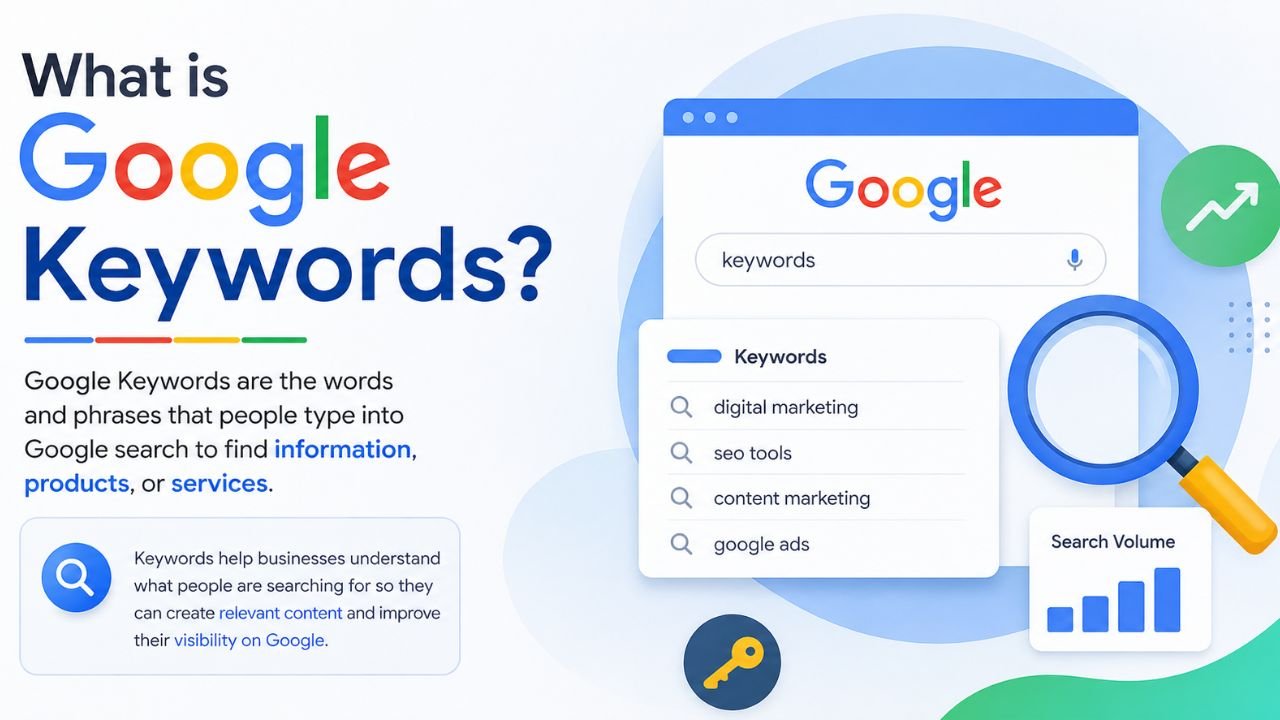
Google keywords are words and phrases that individuals enter into Google in order to seek information, commodities or services. These keywords assist Google in knowing the content of a webpage and when to include it in a search list. To businesses, bloggers and marketers, the keywords on the internet serve as the mediator between their content and their visitors.
When you employ the appropriate keywords in their natural form, your content is more likely to reach the appropriate audience. This will result in the ability to use keywords to add to the number of people visiting the sites, gain more visibility, and attract people interested in everything you have to offer. When one enters something in Google and types the “best wireless headphones”, that phrase is a keyword to the user. It is then focused on the website owners and advertisers to reach out to them.
Understanding what is google keywords becomes easier when you think about everyday searches. Imagine a person wants to buy running shoes. They might search for “running shoes for beginners” or “best running shoes under $100.” Google analyzes those searches and displays pages that seem most relevant.
Keywords help search engines answer three important questions:
- What is this page about?
- Who might find it useful?
- When should it appear in search results?
Without keywords, search engines would struggle to understand the context of web pages.
A simple example can make this clearer. Look at two bakery websites. One speaks generically about cakes and the other has specific information on custom birthday cakes, wedding cakes and delivery of cakes. The latter site provides Google with additional signals in regards to the key words, which means that its likelihood of appearance increases once the customers use Google in place of searching services of that kind.
Keywords also support:
| Benefit | How It Helps |
| Better Visibility | Helps pages appear in relevant searches |
| Higher Traffic | Attracts people looking for related topics |
| Improved Ad Targeting | Shows ads to the right audience |
| Better User Experience | Matches content with search intent |
| Higher Conversions | Reaches users closer to taking action |
The goal is not to add keywords everywhere. The goal is to use them naturally where they make sense.
Short-Tail vs. Long-Tail Keywords: Which Drives Better Traffic?
Not all keywords work the same way. Some attract massive search volumes, while others focus on very specific user needs. Short-tail keywords usually contain one or two words. They are broad, competitive, and often difficult to rank for.
Examples include:
- Shoes
- Fitness
- Insurance
- Marketing
Because these terms are broad, Google cannot always understand exactly what the user wants. Someone searching for “shoes” could be looking for athletic shoes, dress shoes, children’s shoes, or shoe repair services.
Long-tail keywords provide more context. They usually contain three or more words and reveal stronger search intent.
Examples include:
- Best running shoes for flat feet
- Affordable life insurance for families
- Digital marketing agency for small businesses
These keywords attract fewer searches individually. However, they often bring more qualified visitors because users know exactly what they want.
The comparison below highlights the difference.
| Factor | Short-Tail Keywords | Long-Tail Keywords |
| Length | 1-2 words | 3+ words |
| Search Volume | High | Moderate |
| Competition | High | Lower |
| User Intent | Broad | Specific |
| Conversion Potential | Lower | Higher |
A local bakery may struggle to rank for “cakes.” However, ranking for “custom birthday cakes in Chicago” becomes much more realistic and valuable because the searcher has a clear need. Long-tail keywords often produce stronger business results because they target users who are closer to making a decision.
Different Types of Keywords Used in SEO and PPC
Depending on what users wish to achieve, keywords have key functions. These categories are used to make understanding to allow businesses to develop superior content and advertising campaigns.
1. Informational Keywords
Education and learning informational keywords. Individuals make these searches when they require solutions, clarification or directions regarding a subject. Such keywords can be very helpful to create traffic for those users who are not sure about a topic and are still interested in getting this information and making some decisions before doing so.
Examples include:
- How to bake a cake
- What is SEO
- Why website speed matters
These keywords often work well for blog content because they address common questions.
2. Commercial Keywords
Commercial keywords show that a user has been doing research on products or services before purchase. Such searches are typical of comparisons, reviews and recommendations. These keywords are also sought by businesses since they will find users who are already thinking about various options and are in the process of making a buying decision.
Examples include:
- Best CRM software
- Top email marketing tools
- Best laptops for students
These searches often happen during the research stage of the buyer journey.
3. Transactional Keywords
Transactional keywords show strong purchase intent. The searchers who use these keywords already have their minds made up, and are usually willing to make a purchase, reserve a service or quote. Such keywords are more likely to provide better conversion rates since the searcher is near to making a final decision.
Examples include:
- Buy a gaming laptop
- Order a birthday cake online
- Hire an SEO consultant
Users searching these terms often want to take action quickly.
4. Navigational Keywords
Navigational keywords assist the user in arriving at a given site, platform or brand. People do not necessarily need to type down a web address, turn to Google, which can therefore be used as a shortcut to get to the place they already know the name of. Brand names, name of platform or a phrase associated with logging in are common in these searches.
Examples include:
- Facebook login
- Gmail sign in
- YouTube Studio
The user already knows the destination and simply uses Google as a shortcut.
Keywords vs Search Terms: What Is the Real Difference?
Many people use the terms keywords and search terms interchangeably. They are similar, but not cent percent the same. Keywords refer to those expressions that marketers focus on their content or advertising campaigns. Search terms refer to the precise words that users search for using Google. As an illustration, a firm can be planning to generate the keyword:
Running shoes
A user might actually search:
- Best running shoes for beginners
- Running shoes under $100
- Comfortable running shoes for women
Each of those searches represents a search term.
The relationship looks like this:
| Target Keyword | Actual Search Terms |
| Running Shoes | Best running shoes for beginners |
| Running Shoes | Affordable running shoes near me |
| Running Shoes | Running shoes for marathon training |
Understanding this difference helps marketers to develop wider content, which will cater to several search variants as opposed to a specific phrase. This difference would be all the more critical because Google algorithms are getting better. The search engines are now much better equipped to comprehend context and synonyms as well as user intent than it was in the past. Consequently, a single quality article may be ranked dozens or even hundreds of similar search terms.
What Is the Most Searched Keywords on Google and Why It Matters

The answer is different every time, as there is a change in search behavior across the year. The demand to find information in a search can be affected by news events, product launches, trends in entertainment, and technology.
Certain categories consistently generate massive search volumes:
| Category | Common Searches |
| Social Media | YouTube, Facebook, Instagram |
| Technology | AI tools, ChatGPT, smartphones |
| Shopping | Amazon, online deals |
| News | Current events |
| Entertainment | Movies, celebrities, music |
Many websites commit the error of pursuing these huge keywords. Big search volume is appetizing, but relevance is even more important. A local bakery has limited benefits when you find it in a search listing of celebrity-related searches. Targeting the local and industry-specific keywords is usually more beneficial in providing traffic and better conversions.
When you compare intent and volume, this becomes more understandable. A keyword receiving 1,000 searches from interested buyers can outperform a keyword receiving 100,000 searches from people who have no interest in your product or service. That is why experienced marketers focus on audience relevance rather than popularity alone.
Why Search Intent Is More Important Than Keyword Volume
Before researching keywords, it is good to comprehend the reasons why people search. The purpose of a query is called search intent. Google tries to discover this intent as much as possible since it desires to provide the most relevant response.
Four major intent categories dominate search behavior:
| Intent | Purpose |
| Informational | Learn or understand |
| Navigational | Find a website |
| Commercial | Compare options |
| Transactional | Take action |
For example, someone searching “how to start a blog” wants information. Meanwhile, someone searching “buy web hosting today” likely wants to make a purchase. A practical example highlights the difference.
Imagine a person searching:
Best coffee machines for home
This search suggests research and comparison. Later, the same person searches:
Buy Breville coffee machine online
Now the user shows transactional intent. Companies that match content with search intent tend to rank higher and have more engagement since they provide the precise question that the user needs to be answered.
Keyword Forecasting Explained: Predict Traffic Before You Rank
Finding a keyword is only the first step. The next challenge is understanding whether that keyword is worth targeting. This is where keyword forecasts become useful. They assist the marketer to determine the approximate number of visitors, advertisements and the intensity of competitors and prospects before spending time or money on text or campaigns.
Most beginners work on the volume of search. Though the amount of search volume is a significant issue on its own, it only conveys a portion of the narrative. A keyword could receive thousands of searches per month, but might be too competitive a keyword, or too costly to effectively target by a small business. The forecasting of keywords prevents such errors.
Think about a local fitness coach planning a Google Ads campaign. The keyword “personal trainer” may have a large search volume. However, a forecast may reveal high competition and expensive cost-per-click rates. In contrast, a more specific phrase such as “personal trainer for weight loss near me” may offer lower competition and stronger conversion potential.
Several forecasting metrics help marketers make smarter decisions.
| Forecast Metric | What It Shows |
| Average Monthly Searches | Estimated monthly search demand |
| Three-Month Trend | Recent growth or decline |
| Year-Over-Year Change | Long-term popularity trend |
| Competition Level | Number of advertisers targeting the keyword |
| Top of Page Bid | Estimated advertising cost |
| Click Forecast | Potential traffic from ads |
When these figures are considered collectively, they are even more worthy. A moderate volume increasing demand with a medium competition keyword will always be a better opportunity than a very competitive keyword with the growth stumps.
Forecasting also helps identify seasonal opportunities. For example, searches for “Christmas gift ideas” increase significantly during the final months of the year. Businesses and companies that are aware of these tendencies in good time will be able to design the material and advertising campaigns prior to the response of their competitors.
Best Keyword Research Methods for Finding High-Converting PPC Keywords
With the proper tools, keyword research can become a lot easier. Successful marketers use actual search data, as opposed to making guesses of the type of results their customers could want. Such tools provide insights about the search by people, their increasing or declining terms, and areas of latent opportunities. There is no one tool to answer all questions. That is why more mature advertisers tend to use the combination of several research options to create more powerful keyword lists.
1. Google Keyword Planner
Google Keyword Planner is among several keyword research tools that are most popular, as it offers information provided by Google’s advertising platform. It assists companies in finding ideas on keywords, predicting the search volume, and knowing the price of advertising. The tool provides an option to type in a product, service or site URL. Google then provides related suggestions of keywords and helpful performance information.
For example, a business selling home gym equipment might enter the phrase “fitness equipment.” Google could return suggestions such as:
- Home gym equipment
- Adjustable dumbbells
- Exercise machines
- Compact fitness equipment
Alongside these suggestions, users receive valuable metrics that help evaluate opportunities.
| Feature | Benefit |
| Keyword Suggestions | Generates new ideas |
| Search Volume | Shows popularity |
| Competition Score | Reveals advertiser activity |
| CPC Estimates | Predicts advertising costs |
| Traffic Forecasts | Estimates future performance |
The platform has attracted many marketers to begin their research, starting with the discovery of keywords and forecasting tools that are integrated into one dashboard. One more opportunity is the ability to discover long-tail opportunities. Broad keywords often dominate attention, yet more specific phrases frequently generate stronger conversion rates.
2. Google Search Console
While Keyword Planner predicts opportunities, Google Search Console reveals actual performance. This difference makes it one of the most valuable tools available for website owners. Search Console shows the exact queries that already bring traffic to a website. Instead of guessing which keywords work, marketers can see real user searches.
The Performance report provides insights such as:
- Total clicks
- Total impressions
- Average rankings
- Click-through rate
- Search queries
Imagine a travel blog ranking unexpectedly for “budget travel destinations in Europe.” The site owner may discover that users frequently search for this topic. That insight could inspire additional content focused on affordable travel.
Search Console often reveals hidden opportunities because many websites rank for keywords they never intentionally targeted. Another benefit is identifying pages with strong impressions but low click-through rates. Small title or meta description improvements can often increase traffic without creating new content.
3. Google Suggest
Sometimes the simplest tools produce surprisingly valuable results. Google Suggest, also known as Google Autocomplete, falls into that category. When users begin typing into Google’s search box, suggested searches appear instantly. These suggestions come from real searches performed by actual users.
Suppose someone types:
“best laptop for”
Google may suggest:
- best laptop for students
- best laptop for gaming
- best laptop for programming
- best laptop for business
These suggestions provide direct insight into what people want to know.
Many SEO professionals use a simple technique to expand their research. They enter a primary keyword followed by each letter of the alphabet.
For example:
- Digital marketing a
- Digital marketing b
- Digital marketing c
This process often uncovers dozens of keyword ideas that competitors may overlook. Google Suggest works especially well for finding long-tail keywords because it reflects current user behavior rather than historical estimates.
4. SE Ranking
SE Ranking has become a popular choice for marketers who want deeper keyword insights. While Google tools provide essential data, SE Ranking expands the analysis by including competitive intelligence and search visibility metrics. The platform helps users understand not only what people search for but also how difficult it may be to rank for those terms.
Key features include:
| Feature | Purpose |
| Keyword Difficulty | Measures ranking competition |
| Search Volume | Shows demand |
| Search Intent | Identifies user goals |
| SERP Analysis | Evaluates competitors |
| Historical Data | Tracks keyword performance over time |
A useful aspect of SE Ranking is its ability to reveal keyword trends across different locations. Businesses targeting multiple regions can identify opportunities that vary from one market to another.
For example, a keyword may perform exceptionally well in one country while generating little interest elsewhere. Understanding these differences helps businesses allocate marketing budgets more effectively. The platform also allows marketers to analyze competitor rankings. This insight often reveals valuable keyword opportunities that traditional research methods miss.
5. Answer the Public
Many searches begin as questions. People want solutions, recommendations, explanations, and comparisons. Answer the Public focuses specifically on these question-based searches. The platform collects data and organizes keyword ideas around common question formats.
These include:
- What
- Why
- How
- When
- Which
- Where
Suppose someone enters “email marketing.”
The tool may generate questions such as:
- What is email marketing?
- Why is email marketing effective?
- How does email marketing work?
- Which email marketing platform is best?
These insights help content creators build articles that directly address user concerns. Question-based keywords also align well with featured snippets and AI-generated search experiences. Since users increasingly search using conversational language, these keyword opportunities continue to grow in value.
6. Google Trends
Keyword popularity rarely stays constant. Some topics gain momentum quickly, while others lose relevance over time. Google Trends helps marketers track these changes. Unlike traditional keyword tools, Google Trends focuses on relative popularity rather than exact search volume.
This makes it useful for:
- Seasonal planning
- Trend monitoring
- Topic comparisons
- Market research
Consider a business selling holiday decorations. Search demand rises sharply during specific months of the year. Google Trends helps identify those peaks, allowing businesses to prepare content and advertising campaigns in advance. The tool also compares multiple keywords side by side.
| Keyword | Trend Pattern |
| Christmas Decorations | Strong seasonal spikes |
| Home Decor | Consistent year-round demand |
| Halloween Costumes | Seasonal growth |
| Wedding Decorations | Moderate seasonal fluctuations |
Google Trends can also reveal emerging opportunities. A rapidly growing search term may signal a topic worth targeting before competition increases.
This type of early insight often gives marketers a significant advantage.
Many businesses combine Google Trends with Keyword Planner because the two tools complement each other. One provides search volume estimates, while the other highlights changes in popularity over time.
By using these research methods together, marketers gain a much clearer picture of user behavior and keyword opportunities. Strong keyword research rarely depends on a single source. Instead, it combines forecasting, trend analysis, search data, and competitive insights to create a strategy that attracts qualified traffic rather than random visitors.
How to Use Keywords with Google Ads for Better Results?
Finding good keywords is only half the job. The next step involves using them correctly inside Google Ads. Many advertisers build a large keyword list and expect immediate results. However, success usually comes from organization, relevance, and continuous optimization rather than simply adding more keywords.
Google Ads uses keywords to determine when an advertisement becomes eligible to appear. When a user searches for a related term, Google evaluates the keyword, ad quality, landing page experience, and bidding strategy before deciding whether to display the ad. A well-structured campaign often starts with tightly focused ad groups. Instead of placing every keyword into one group, marketers separate them based on themes and user intent.
For example, a company selling running shoes could organize its campaigns like this:
| Ad Group | Sample Keywords |
| Running Shoes | Running shoes, lightweight running shoes |
| Trail Running Shoes | Trail running shoes, off-road running shoes |
| Women’s Running Shoes | Women’s running shoes, ladies running shoes |
| Marathon Shoes | Marathon running shoes, race day shoes |
This structure helps Google understand the relationship between keywords and advertisements. As a result, the platform can deliver more relevant ads to users. Another important factor is keyword relevance. If someone searches for “best trail running shoes,” they expect to see an ad about trail running shoes. Sending them to a general footwear page often leads to lower engagement and wasted advertising spend.
Choosing the Right Keyword Match Types
Google Ads offers several keyword match types that control how closely a user’s search must match a selected keyword. Each match type provides a different balance between reach and control.
| Match Type | Example | Reach |
| Broad Match | running shoes | Highest |
| Phrase Match | “running shoes” | Moderate |
| Exact Match | [running shoes] | Most Targeted |
- Broad match can generate a large amount of traffic because Google may show ads for related searches. While this increases reach, it can also attract irrelevant clicks.
- Phrase match offers more control because the search generally needs to contain the keyword phrase.
- Exact match provides the highest level of precision. Advertisers often use it when they want to target highly specific searches with strong commercial intent.
Many experienced advertisers combine multiple match types to balance traffic volume and relevance.
Why Negative Keywords Matter?
One of the most overlooked parts of Google Ads is negative keywords. Negative keywords prevent ads from appearing for irrelevant searches. This simple feature can save significant advertising budget. Imagine a company selling premium software. If its ads appear for searches containing “free software,” many clicks may come from users who never intend to purchase. Adding “free” as a negative keyword helps eliminate those unwanted impressions.
Common negative keywords include:
- Free
- Cheap
- Jobs
- Careers
- Internship
- Tutorial
The exact list depends on business goals and target audiences. By filtering irrelevant searches, advertisers improve click quality and often increase conversion rates.
Create Keyword-Driven Search Ads That Match User Intent
Strong keyword research becomes valuable only when it influences ad creation. Every successful search ad starts with a clear understanding of what users want. People click ads because they expect answers. If the ad reflects their search intent, engagement usually improves.
For example, a person searching for “best CRM software for small business” wants a solution tailored to small businesses. An advertisement mentioning enterprise software may fail to connect with that audience. A keyword-focused search ad generally includes four important elements. Consider this example:
- Search Query: Affordable accounting software
- Headline: Affordable Accounting Software for Small Businesses
- Description: Simplify invoicing, track expenses, and manage finances with one easy platform.
- CTA: Start Your Free Trial Today
Notice how the keyword appears naturally within the headline. The description also addresses a likely user need. This alignment helps improve ad relevance. Google rewards relevant ads because they create a better user experience. Higher relevance often contributes to stronger Quality Scores, lower costs per click, and better ad positions.
Writing Headlines That Reflect Search Intent
Headlines often determine whether a user clicks or ignores an ad.
Strong headlines usually do one or more of the following:
- Include the primary keyword
- Highlight a benefit
- Address a problem
- Mention a unique selling point
A generic headline such as “Great Software Solutions” tells users very little. A more focused headline such as “Affordable CRM Software for Small Teams” immediately communicates relevance. Small improvements in headlines can significantly impact click-through rates over time.
Aligning Landing Pages With Keywords
Many campaigns lose conversions because the landing page fails to match the keyword and advertisement. Suppose someone clicks an ad for “custom birthday cakes.” If the landing page displays general bakery products, visitors may leave quickly. A dedicated page about custom birthday cakes creates a smoother experience.
This consistency benefits both users and advertisers. Google evaluates landing page relevance when calculating Quality Scores. Better alignment often leads to improved performance across the entire campaign.
What Is the Most Searched Keywords on Google and Why Search Volume Can Be Misleading
Search volume certainly matters, but it should never be the only factor guiding keyword decisions. A keyword attracting one million monthly searches may look impressive. Yet ranking for that keyword could require significant resources, years of authority building, and substantial advertising budgets. A smaller keyword often provides better results.
Consider these examples:
| Keyword | Monthly Searches | Intent |
| Shoes | Very High | Broad |
| Running Shoes for Flat Feet | Moderate | Specific |
| Waterproof Trail Running Shoes | Lower | Highly Specific |
The first keyword reaches a broad audience. However, the third keyword targets users who know exactly what they need. Specific searches often produce higher conversion rates because the user has already narrowed their preferences.
This principle applies across industries. A local plumber may gain more business from “emergency plumber in Dallas” than from trying to rank for the keyword “plumber.” Search volume should guide decisions, but user intent should drive them.
Common Keyword Research Mistakes That Limit Results
Many businesses invest time in keyword research yet still struggle to achieve meaningful results. In most cases, a few common mistakes are responsible.
One frequent mistake involves targeting only high-volume keywords. While these phrases attract attention, they also attract intense competition. Another mistake occurs when marketers ignore search intent. A keyword may generate traffic, but traffic alone does not guarantee conversions.
Keyword stuffing remains another issue. Some website owners continue adding the same phrase repeatedly in hopes of improving rankings. Modern search engines no longer reward that approach. Instead, Google values natural language, topic relevance, and user experience.
The table below summarizes several common mistakes.
| Mistake | Potential Impact |
| Chasing Only Volume | High competition |
| Ignoring Intent | Low conversions |
| Keyword Stuffing | Poor readability |
| Skipping Long-Tail Keywords | Missed opportunities |
| Not Updating Research | Outdated strategy |
Avoiding these mistakes often produces faster improvements than constantly searching for new keywords.
A Practical Example of Keyword Research in Action
Imagine a local bakery trying to increase online cake orders. At first, the bakery targets broad keywords such as:
- Cakes
- Bakery
- Birthday cakes
Despite decent traffic, sales remain inconsistent.
After conducting deeper keyword research, the business discovers more targeted opportunities:
- Custom birthday cakes near me
- Same-day cake delivery
- Vegan birthday cakes
- Wedding cake bakery Chicago
The search volume for these keywords is lower. However, visitors arriving through these searches show much stronger buying intent. As a result, the bakery attracts fewer visitors overall but generates more orders. This example highlights an important lesson. Better keywords often outperform bigger keywords. The goal is not simply to attract traffic. The goal is to attract the right traffic.
Final Thoughts
Understanding what is google keywords helps businesses make smarter decisions about SEO, content marketing, and advertising. Keywords reveal how people search, what information they want, and which solutions they need. The strongest keyword strategies focus on relevance rather than popularity alone. While many beginners spend time chasing trends and asking what is the most searched keywords on google, experienced marketers look deeper. They study intent, competition, and user behavior before choosing which opportunities deserve attention.
A successful keyword strategy is never static. Search habits change, industries evolve, and new opportunities appear every year. Businesses that regularly review their keywords, analyze performance data, and create content around genuine user needs often build stronger long-term visibility. Instead of searching for the perfect keyword, focus on understanding the audience behind the search. That approach usually delivers better rankings, better traffic, and better business results.
FAQs
Google keywords are the words and phrases people type into Google when searching for information, products, or services.
Keywords help search engines understand page content and match it with relevant user searches.
Keywords are phrases marketers target, while search terms are the exact queries users enter into Google.
You can use tools such as Google Keyword Planner, Search Console, Google Trends, and Answer the Public to discover keyword opportunities.
Long-tail keywords usually attract more targeted visitors and often convert better because they show stronger intent.
The most searched kewords vary regularly, but categories such as social media, technology, news, and entertainment consistently attract large search volumes.
Most businesses benefit from reviewing keyword performance every few months and adjusting strategies based on trends and search behavior changes.
Yes. A well-optimized page can rank for many related keywords and search terms when it covers a topic thoroughly and naturally.