
In 2026, artificial intelligence was quicker than anyone anticipated. New systems are no longer acting as simple assistants. Instead, they are team players who realize objectives and accomplish tasks one step at a time. Such a change renders the debate on gpt 5.3 codex vs claude opus 4.6 more significant to the developers and businesses, as well as non-technical users. In this paper, you will clearly get a view of what these tools indeed do. In addition, you will observe how they vary in practical application, as well as theory. Meanwhile, the content describes the phenomenon of claude opus 4.6 vs gpt 5.3 codex comparison and gpt-5.3-codex vs claude opus 4.6 benchmarks in a clear and simple manner. Hence, you will not be perplexed about which model is suitable to your working style. This time, we’ll take each system individually and examine its functionality.
About OpenAI’s GPT-5.3 Codex
GPT-5.3 Codex was the work of OpenAI and was much more than a coding assistant. Rather, it is considered as more of an active software operator, capable of acting on a system, has the ability to work over processes and has the ability to support complete software development cycles. Due to this, developers are relying on it not just to write code but also to debug, test and deploy.
Besides, GPT-5.3 Codex brings about a concept of passive suggestions to active participation. It does not await a lesson line by line. Rather, it breaks down the objective and steps chronologically towards achievement. Due to this, teams have quicker output and a reduced number of manipulations. Moreover, the model also supports terminal-level operations, being able to run commands and handle environments directly.
Core Capabilities of GPT-5.3 Codex
- Writes production-ready code across multiple languages
- Executes terminal commands and automates workflows
- Debugs errors and optimizes performance
- Generates technical documentation with clarity
Exploring Anthropic’s Claude Opus 4.6
Claude Opus 4.6 provides the other type of intelligence on the other side of the gpt 5.3 codex vs claude opus 4.6. It is concerned with rational thinking, intelligence and logical understanding. As such, it is ideal that assignments should be analysed rather than performed on the spot.
A big context window is introduced in Claude Opus 4.6. It enables it to handle large amounts of information without missing any. As a result, users will be able to submit complete documents, lengthy discussions, or multifaceted datasets. Furthermore, it can be accurate as the size of input increases to a high magnitude.
To better understand its strengths, consider the following table.
| Feature Area | Capability Level |
| Reasoning | Very High |
| Context Handling | Industry Leading |
| Collaboration | Advanced |
| Execution Ability | Moderate |
Thus, in the claude opus 4.6 vs gpt 5.3 codex comparison, Opus focuses more on thinking and planning rather than direct action. It supports strategic work where understanding matters more than speed.
Gpt-5.3-codex vs claude opus 4.6 Benchmarks Explained Clearly
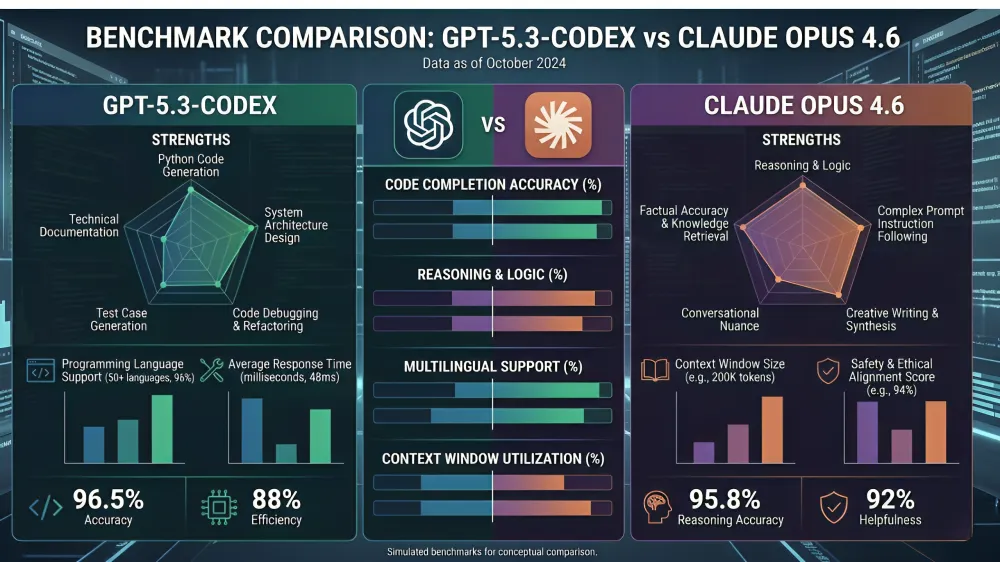
Benchmarks give objective demonstrations of performance. Nevertheless, they do not present all the picture. Nevertheless, they assist users to comprehend the strengths and weaknesses. Thus, gpt-5.3-codex vs claude opus 4.6 benchmarks analysis will be necessary. These standards are used to test real-world problems like coding, reasoning, and system-level execution. Consequently, they show the performance of each model in pressure.
Benchmark Performance Comparison
| Benchmark Type | GPT-5.3 Codex | Claude Opus 4.6 | Stronger Model |
| Terminal Tasks | 77.3% | 65.4% | Codex |
| Software Engineering | 56.8% | Moderate | Codex |
| Verified SWE Tasks | 80.0% | 81.42% | Opus |
| OS-Level Execution | 64.7% | 72.7% | Opus |
| Reasoning Tests | Moderate | Industry Leader | Opus |
From the table, a clear pattern emerges. Codex is more successful in execution ones. At the same time, Opus can be better used in those circumstances where arguments play an important role. Thus, the notion that both models are utilized according to different aims is supported with the help of benchmarks. Besides, developers usually observe that Codex solves smaller coding challenges quicker. Opus on the other hand, does better when there is multiplicity of thinking involved in the tasks.
Core Differences in gpt 5.3 codex vs claude opus 4.6 Performance
Understanding the core differences helps users choose the right tool. The blank in gpt 5.3 codex vs claude opus 4.6 is not quality. Rather, it is associated with purpose-workflow agreement.
Codex pays attention to action. It finishes tasks, carries out commands and constructs systems. On the other hand, Opus is an understanding person. It processes information, premeditates plans, and plans complicated tasks.
Major Differences Explained
| Category | GPT-5.3 Codex | Claude Opus 4.6 |
| Primary Strength | Execution | Reasoning |
| Workflow Style | Task-oriented | Strategy-oriented |
| Speed | Faster actions | Slower but deeper |
| Complexity Handling | Moderate | Very High |
Moreover, they have different agent systems. Codex is user directed. Opus enables agents to work on their own. Therefore, Codex is based on well-organized workflows whereas, Opus on dynamic projects.
Pricing and Accessibility in claude opus 4.6 vs gpt 5.3 codex comparison
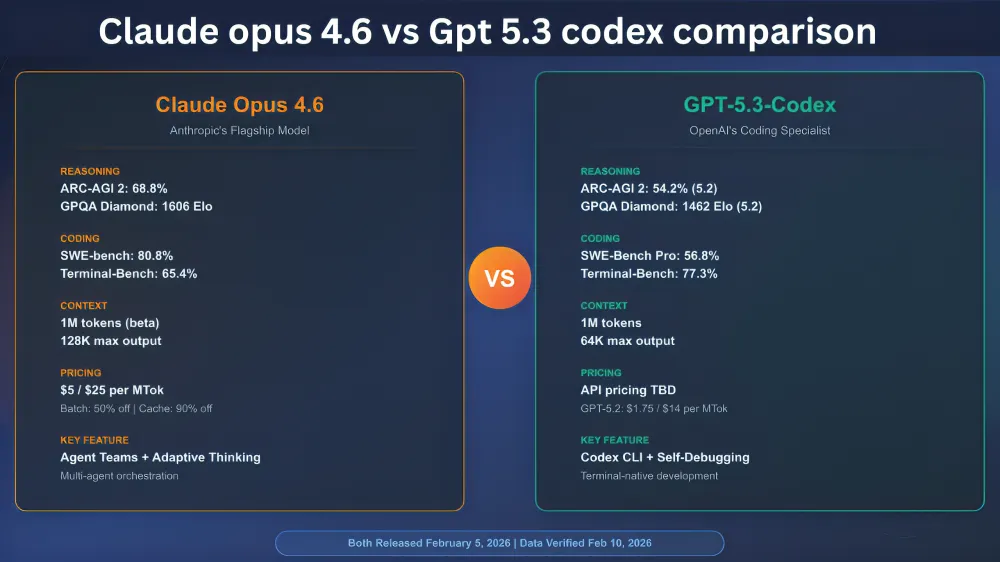
Adoptions are affected by prices. Thus, cost model comparisons will be significant during the claude opus 4.6 vs gpt 5.3 codex comparison. GPT-5.3 Codex is a subscription-based model. This makes budgeting easy. Users are aware of their monthly payments. Conversely, Claude Opus 4.6 is a token-based pricing. Consequently, the prices are different depending on the use.
Pricing Overview:
| Model | Pricing Model | Cost Predictability |
| GPT-5.3 Codex | Subscription | High |
| Claude Opus 4.6 | Token-based | Variable |
Moreover, the availability is also different. Codex is integrated with development environments. In the meantime, Opus ties together by APIs and enterprise software. As such, Codex can be conveniently adopted by developers at first. However, Enterprises have favored Opus due to its scaling and organized integration.
Choosing the Right Tool in gpt 5.3 codex vs claude opus 4.6
The decision between these models is based on your objectives. In the gpt 5.3 codex vs claude opus 4.6, there is no winner. Rather, every tool is a tool for a certain need. Codex is more suitable if you build applications, fix bugs, or automate systems. It is fast and works efficiently. Conversely, when you are doing research, analyzing, or processing a lot of data, then Opus will work better.
Decision Summary:
| Use Case | Recommended Model |
| Software Development | GPT-5.3 Codex |
| Data Analysis | Claude Opus 4.6 |
| Automation | GPT-5.3 Codex |
| Strategic Work | Claude Opus 4.6 |
Also, a significant number of teams integrate the tools. They employ Codex to implement and Opus to plan. Consequently, they are more productive and perform well.
Final Thoughts
The debate between the gpt 5.3 codex vs claude opus 4.6, demonstrates the progress of AI, as it starts to become more than just a tool. Now these systems facilitate real work process and intricate thinking. This is why users need to make decisions grounded on practical requirements and not hype.
Codex brings about speed and performance. Opus presents substantiality and logic. The most appropriate decision, therefore, follows on your expectation of AI. When you synchronize your work with the appropriate model, you will get high results with minimum efforts.
Read About More Tools: