
You can publish great content, improve page speed, and build strong backlinks, yet search engines still need a reliable way to discover and understand your pages. That’s where XML sitemaps come into play. The problem is that many website owners do so much work to create the content on their website, but very little work to work on search engines – how they discover content. Truthfully, even the best article can’t rank if the search engines are not able to find and properly crawl it. If you’re like almost everyone else and have looked into What is a sitemap xml, chances are you’ve found yourself wondering if it is relevant for SEO in 2026. Yes, this is a short answer, of course. Although search engines have grown more adept over the years, they still need clear cues that enable them to quickly and accurately cover your website. Those signals are given in an XML sitemap.
A sitemap is useful for blogs with few pages as it makes it easier for search engines to find new pages. For really large websites, it turns into a must-have instrument to order thousands of URLs. It can be a pivotal factor in eCommerce stores, news sites and multilingual platforms’ crawl efficiency and indexing performance. Many people also mix up XML sitemaps with HTML sitemaps and/or sitemap generators. All these terms sound similar, and it makes sense that everyone would be confused. From what is a sitemap, to what’s a sitemap generator, through XML sitemaps and why they’re important for SEO and how they’re critical to maintaining visibility in an AI-powered search experience, this article covers them all.
| Quick look: What Is a Sitemap XML? An XML sitemap is used to highlight on your website those most important URLs, and subsequently, it’s employed to notify search engines that you have content they should discover, crawl and index faster. It works as a map for Google, Bing, and others, which displays pages that are important and when they were last updated. |
What Is a Sitemap XML and Why It Matters for SEO in 2026
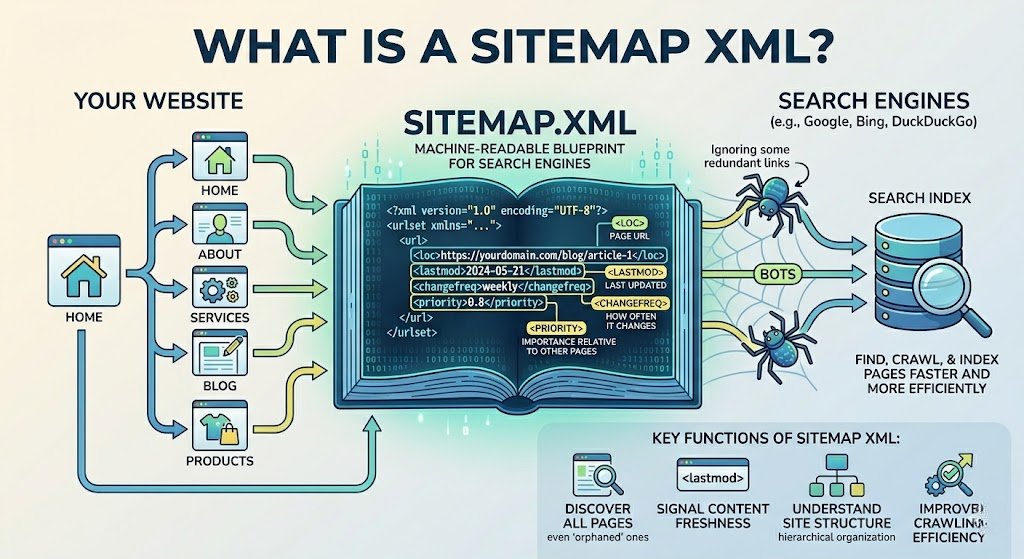
An XML sitemap is a document in the structured XML format, which lists important URLs on your website. This is the standard file upon which search engines rely when crawling and indexing content. A sitemap provides the crawler with additional information, which helps them to avoid exploring all the pages of your site without any purpose if they are not necessary.
Just think of a map of the city. A visitor may take a random path and reach key locations anytime. But, having a map provides a faster way and saves a detour. Search engines will similarly use the XML Sitemap concept.
The file can include information such as:
- Website URLs
- Last modification dates
- Content update signals
- Media-related information
- Sitemap organization data
Although a sitemap doesn’t directly affect the ranking of your site, it helps them to grasp your site better. It allows for better and improved indexing in the long term and stronger visibility.
What Is a Sitemap? Understanding the Difference Between HTML and XML Sitemaps
A common misconception is that every sitemap serves the same purpose. When people search what is a sitemap, they are often referring to any structured list of website pages. In reality, there are different types of sitemaps designed for different audiences. Some sitemaps help users navigate websites, while others help search engines crawl them.
The comparison below highlights the difference.
| Feature | HTML Sitemap | XML Sitemap |
| Purpose | User navigation | Search engine crawling |
| Audience | Visitors | Search engines |
| Visible on website | Yes | Usually hidden |
| SEO impact | Indirect | Direct |
| Supports metadata | No | Yes |
An HTML website map resembles a visitor’s manual. Its format describes pages in the way they can be “browsed”. In the case of XML, a Sitemap is a special form that concentrates solely on search engines and is filled with technical detail to guide search engine crawlers in understanding the website content. Some sites utilize both because they are both useful.
How XML Sitemaps Help Search Engines Discover Your Website
XML sitemaps are intended to signal search engines about the content of a website. Many pages can be discovered by internal links by search engines, but it is not the case for all. Larger websites may have deep lands, archived material, product lists, media material, and more that may be missed by crawlers.
XML sitemaps reduce that risk by providing a complete list of important URLs.
This becomes especially useful when:
- A website has thousands of pages
- Content updates frequently
- Internal linking is weak
- New pages need quick indexing
- Media content plays a major role
Suppose you have a travel site that offers travelers destination guides in hundreds of cities. Some pages may be a couple clicks away from the home page. Even when a website becomes complex with many ways to reach those pages, a sitemap helps search engines discover the existence of such pages.
What Does an XML Sitemap Look Like?
XML sitemaps are easy for Google to understand. It uses specific tags and structured data that enable search engines to automatically read. A typical map entry is the information about a single URL plus potentially some information about changes made to that content.
| Tag | Requirement | Purpose |
| <?xml> | Mandatory | Defines XML version |
| <urlset> | Mandatory | Contains all URLs |
| <url> | Mandatory | Represents a page |
| <loc> | Mandatory | Displays URL location |
| <lastmod> | Optional | Shows update date |
| <changefreq> | Optional | Suggests update frequency |
| <priority> | Optional | Suggests importance level |
Google focuses on real date of changes and updates. There are still optional fields, but meaningful fields receive more attention than fields set by the search engine human. A well-designed sitemap helps bots to navigate and understand the information effectively.
What Is an XML Sitemap Index?
Large websites often require multiple sitemap files because sitemap size limits exist. Using a Sitemap Index, website owners can instead submit a single file that contains a list of dozens or even hundreds of other files. A sitemap index is a super sitemap that links to other individual sitemaps.
The difference becomes easier to understand through comparison.
| Feature | XML Sitemap | Sitemap Index |
| Contains URLs | Yes | No |
| Contains sitemap files | No | Yes |
| Best suited for | Small and medium websites | Large websites |
| Main purpose | URL discovery | Sitemap organization |
For instance, a web store may develop different sitemaps for products, category, blog posts and visuals. There is one single file, called sitemap index, that ties them together. This allows for sites that have a lot of content to be read and understood by search engines more quickly, and while it makes sitemap management easier, it won’t be complicated either.
Benefits of XML Sitemaps for Faster Crawling and Better Indexing
Technically, websites can exist without XML sitemaps. Pages can still be found by search engines who use links and other references. However, the whole of these systems are not very effective and can cause indexing gaps and slow discovery. Sitemap gives direction. It informs the search engines and tells them which pages are important, where they could be found, and when they were updated. This clarity presents a number of valuable SEO benefits.
Improved Crawl Efficiency
Search engines has limited limitation in providing crawl budget which allows them to explore a website. They have a finite amount of time to spend exploring pages. An XML sitemap lets the search engines concentrate on key urls and not expend resources on less significant pages. This makes it easier for search engines to index websites. The growth of sites makes this benefit even more crucial.
Faster Indexing of New Content
The posting of a page doesn’t guarantee the page will be in search results. Content needs to be found and indexed by search engines. Frequent updates to a sitemap means that search engines are given a more reliable indication of new information. This can often provide quicker indexing. For example, news websites. Time is of the essence when it comes to breaking stories and if search engines find out about them a day after it happens, it loses its value. New sitemaps enable search engines to locate more fresh content earlier.
Discovery of Orphan Pages
Orphan pages are those web pages that are present on a web page that do not have any internal links. Typically, orphan pages are not recommended because they rarely get links from other pages. A sitemap addresses this problem, by enumerating those pages directly. This gives valuable content a chance to show up in search engine results, even if the site’s navigation isn’t ideal.
Additional Metadata Signals
XML sitemaps can offer more to SEO than just URL discovery. The great way is the “last modified” date. It is the information that search engines will use to decide if another search engine crawl is necessary. Regular updates to website content enable accurate metadata to play a role in search engines prioritizing the fresh content.
Support for Specialized Content
Many websites contain more than standard webpages.
Examples include:
- Images
- Videos
- News articles
- Product catalogs
- Interactive content
These content types often make Google understand the website better with the aid of specialised sitemaps. Using an image sitemap can help to make it easier for users to find images in the search results. Search engines are more likely to be able to find and index video information with the help of a video sitemap. This provides other avenues of visibility that don’t rely on search engines.
Better Understanding of Site Structure
The structure of the web affects the relationship between the website’s content. A sitemap gives an overview of categories, content clusters and sections of significance. Knowing this structure better, search engines can do a deeper search for the content and make better sense of the relationship between pages.
Indexing Insights Through Search Console
Google Search Console can provide significant details by submitting a sitemap. The website owners can go to their websites and reach out to a list of URLs that have been indexed and check if they have any problems.
| Search Console Metric | What It Reveals |
| Submitted URLs | Pages listed in sitemap |
| Indexed URLs | Pages stored in search index |
| Crawl errors | URLs with technical issues |
| Warnings | Potential indexing concerns |
This information helps uncover technical SEO problems before they affect traffic.
Support for Multilingual Websites
Special challenges for multilingual sites are they serve different languages and regions. XML sitemaps can provide support for hreflang and facilitate language differences recognition in search engines. This helps to optimize the chances of users seeing the right version of a page depending on their geographic and/or language settings. This feature is especially beneficial for global companies.
How XML Sitemaps Help Optimize Crawl Budget
Google gives each site a fixed amount of crawling time, called crawl budget. This budget defines a search engine’s crawl rate for a certain amount of time. For a smaller website, crawl budget rarely is a concern. For larger websites, those with thousands of URLs, improved crawl management can be of great importance.
This XML-sitemap is used to direct those search engines to focus on good pages and not expend resources on less important ones. However, critical content is crawled more efficiently, particularly on large blogs, news sites and eCommerce stores. Search engines can devote more attention to analysis of new content on the page and less time checking their way to the base.
How XML Sitemaps Support AI Search and Google AI Overviews
Although AI-powered search is evolving as we speak, there still needs to be a strong foundation of content before it can be displayed in AI-generated responses. One of the foundations of most AI systems is search indexes for discovery. When search engines don’t crawl and index the content, AI systems could never be able to access it. That’s why in 2026, the question of what is a sitemap xml is still relevant.
A sitemap helps search engines:
- Discover content faster
- Identify updated pages
- Maintain fresher indexes
- Understand website structure
These factors are indirectly related to AI presence, as AI systems tend to fetch information from indexed content. Having a sitemap doesn’t guarantee that the content will appear in answers from artificial intelligence. It does help to beef up search filtering behind which the AI-powered searches are riding.
XML Sitemap vs Robots.txt: Understanding the Difference
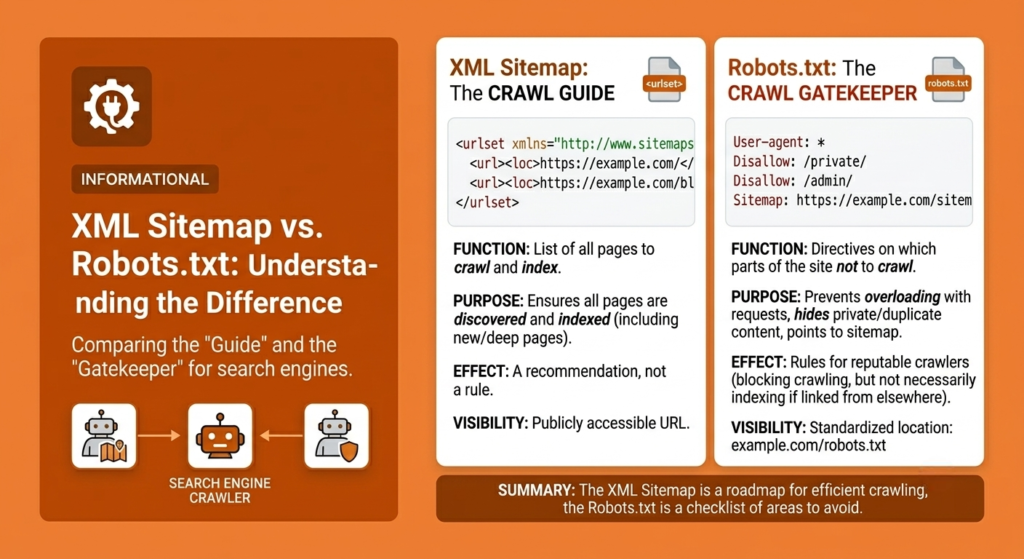
Website owners often assume XML sitemaps and robots.txt files serve the same purpose. In fact, they have quite different roles. A sitemap file enables search engines to reach all pages of a website, and robots.txt prohibits robots from entering certain sections of a website.
| Feature | XML Sitemap | Robots.txt |
| Purpose | Helps discover URLs | Controls crawler access |
| SEO Role | Supports indexing | Controls crawling |
| Contains URLs | Yes | No |
| Affects Discovery | Yes | Indirectly |
| Used By Search Engines | Yes | Yes |
Both when used correctly, will form a better technical foundation. Robots.txt works for guiding the spider and XML sitemaps works for guiding the spider’s discovery.
What Is a Sitemap Generator and How Does It Simplify Website Management
As websites grow, manually maintaining sitemap files becomes impractical. What is a sitemap generator comes into play. A generator for creating sitemap files automatically and updating them when content changes. Website owners can use software to handle editing XML code, rather than doing it by hand.
Popular sitemap generators include:
| Tool | Platform |
| Yoast SEO | WordPress |
| Rank Math | WordPress |
| XML-Sitemaps.com | General websites |
| Screaming Frog | Technical SEO |
| Shopify Sitemap | Shopify stores |
There are several benefits to automation. It decreases human mistakes, maintains updated sitemaps and spares a tremendous amount of time. For website owners who don’t want to make too much effort, the easiest solution is to create a website map using a sitemap generator.
Common XML Sitemap Mistakes That Can Hurt SEO
Although XML sitemaps are rather easy to set up, websites tend to make several errors that diminish the value of this mark-up. You may end up missing out on ranking opportunities, run into indexing difficulties, and be inefficient in crawling for small site map troubles.
| Mistake | Potential Impact |
| Including noindex pages | Wastes crawl resources |
| Listing broken URLs | Creates crawl errors |
| Outdated sitemap files | Delays content discovery |
| Duplicate URLs | Confuses search engines |
| Missing sitemap submission | Slower indexing |
| Incorrect lastmod dates | Reduces crawl efficiency |
Checking on a regular basis sitemap health avoids these and maintains search engines with accurate information.
How to Create and Manage XML Sitemaps Using Yoast SEO
Yoast SEO remains one of the most widely used sitemap solutions for WordPress websites. The plugin automatically generates sitemap files and updates them whenever content changes. This removes the need for manual management. Many website owners never need to touch XML code because Yoast handles the technical work automatically.
A Smarter Analysis in Yoast SEO Premium
The premium version expands SEO analysis while continuing to automate sitemap management. Website owners receive deeper optimization insights while maintaining accurate sitemap files behind the scenes.
Controlling What Appears in Your Sitemap
Not every page deserves inclusion in a sitemap. Login pages, duplicate URLs, internal search results, and thank-you pages rarely provide value in search results. Yoast allows users to decide which pages appear and which remain excluded. This control helps maintain a cleaner sitemap and improves crawl efficiency.
Make Google Find Your Sitemap
Creating a sitemap is only one step. Submitting it through Google Search Console helps search engines discover it quickly and provides valuable reporting data. The process takes only a few minutes and can reveal useful insights about indexing performance.
What Websites Need an XML Sitemap?
Almost every website benefits from having a sitemap.
Some websites gain even greater value, including:
- Large websites
- ECommerce stores
- News publishers
- Media-heavy websites
- New websites
- Multilingual websites
As websites expand, sitemap management becomes increasingly important.
Which Pages Should Be in Your XML Sitemap?
A simple rule works well here. Include pages that deserve visibility in search results. These usually include blog posts, product pages, service pages, category pages, and informational resources. Pages with little search value should remain excluded.
Example: A New Blog
Imagine launching a new blog with twenty articles. Those articles should appear in search results, so they belong in the sitemap. A thank-you page shown after a newsletter signup serves a different purpose. Since users rarely search for it, excluding it makes more sense.
Conclusion: How to Audit and Improve Your XML Sitemap for Better SEO Results
Many website owners create an XML sitemap once and never review it again. That approach often leads to outdated URLs, indexing gaps, and missed SEO opportunities. A healthy sitemap should evolve alongside your website and reflect your most valuable content accurately.
If you understand what is a sitemap xml and maintain it properly, you make it easier for search engines to discover important pages, process updates, and understand your site structure. Whether you run a small blog or a large eCommerce platform, an updated sitemap remains one of the simplest ways to support long-term SEO performance. Taking a few minutes to review your sitemap today can help search engines find the content that matters most tomorrow.
FAQs About XML Sitemaps
Yes, although a sitemap improves discovery and crawl efficiency.
Every time important content changes or new pages are published.
No. XML sitemaps do not directly improve rankings, but they help search engines discover and index content more efficiently.
A single XML sitemap can contain up to 50,000 URLs or reach a maximum file size of 50 MB.
Yes. Specialized image and video sitemaps help search engines understand and surface media content more effectively.
Yes. Even websites with fewer pages benefit from faster discovery and better indexing support.
Explore More Blogs: